Google Drive is a cloud storage tool. Brandy is a brand asset management platform. While Google Drive stores files, Brandy organizes logos, colors, fonts, and Google Drive Alternative for Brand Asset Management and guidelines in a structured, shareable brand space. Built for agencies, franchises, and brand teams who need more than a folder.
Brandy vs Google Drive: Feature Comparison
| Feature | Google Drive | Brandy |
|---|---|---|
| Purpose | General file storage | Brand asset management |
| Brand guidelines | No | Yes: full guidelines pages |
| Organized brand assets | Folders only | Structured brand spaces |
| White label | No | Yes: BrandOS plan |
| Multi-brand management | Nested folders | Unlimited brand spaces |
| Sharing | File and folder links | Public brand space URL |
| Permissions | Basic view and edit | Role-based access control |
| AI features | No | Yes: AI brand consciousness |
| Free plan | 15GB unstructured storage | 20 brand assets + full guidelines |
Why Teams Switched from Google Drive to Brandy
Google Drive is a tool most teams already use. It is reliable, fast, and free to start. But when it comes to managing brand assets, Google Drive creates more problems than it solves.
Think about what happens when a new vendor needs your logo. Someone emails a folder link. The vendor downloads the wrong version. The files have no context: no color codes, no usage rules, no guidelines. The result is off-brand materials and avoidable back-and-forth.
Google Drive was built for file storage and document collaboration. It was not built for brand management. There are no brand guidelines, no visual asset organization, and no way to present your brand professionally to the outside world.
Brandy was built specifically for this problem. Every brand gets a dedicated space with organized logos, color palettes, typography, brand voice, and guidelines, all accessible via a single shareable URL. When a vendor needs your logo, you send them one link. They see exactly what you want them to see.
The Problem with Folder-Based Brand Management
The deeper issue with Google Drive for brand management is not storage. It is structured. Folders are neutral containers. They hold files without communicating what those files mean, how they should be used, or which version is current.
A brand asset is not just a file. A logo needs context: which variant is for print, which is for digital, the minimum size requirements, and the backgrounds it should never appear on. A color code needs to be paired with its RGB and CMYK equivalents so the right values reach the right production environment.
Google Drive cannot attach that context to a file. Brandy is built around it.
What Happens Without a Dedicated Brand Tool
The practical cost of managing brand assets in Google Drive accumulates in ways that feel minor until they compound. A designer is working from an outdated logo because the current version was not clearly labeled. A printer received the wrong color profile because the vendor had created its own version of the file. A new hire is spending their first week asking colleagues for assets that should be immediately accessible.
Every one of those moments represents time, money, and brand equity lost. A dedicated brand asset management platform eliminates them at the source.
What Brandy Does That Google Drive Cannot
Google Drive gives you folders. Brandy gives you a brand space.
The difference matters. A folder is a container for files. A brand space is a structured environment where every asset has context: the right file formats, usage notes, color codes, and brand guidelines all in one place.
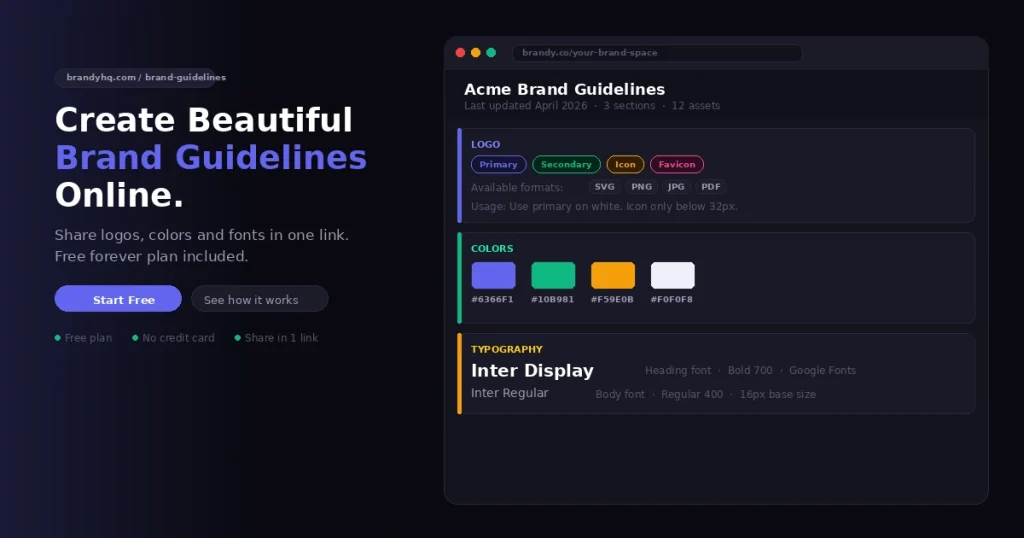
With Brandy, your logos are displayed visually with downloadable formats for easy access. Color palettes appear as organized swatches with hex codes and usage guidance, while typography is showcased in real context. Your brand guidelines stay clear, shareable, and consistently up to date.
None of this is possible in Google Drive. You can approximate it with clever folder naming and shared documents, but it requires constant maintenance and still lacks the visual presentation that makes brand management effective.
Visual Organization That Communicates Brand
The most significant practical difference between Google Drive and a dedicated brand platform is how assets are presented. In Google Drive, a logo is a filename in a list. In Brandy, it is a visual asset displayed in context, with every approved variant available for download in the correct format.
This matters because most of the people accessing brand assets are not designers. A marketing manager, a PR agency, a franchise partner, a new hire joining remotely: these are the people who need brand assets most often, and they are the least equipped to navigate folder structures and file naming conventions without visual guidance.
Brandy makes the correct, obvious choice. The right logo, in the right format, with the right usage guidance, is one click away for anyone with access.
Real-Time Updates That Reach Everyone
When you update a brand asset in Google Drive, you upload a new version of the file. The old file remains where it is. Everyone who downloaded it before the update is now working from the wrong version, and there is no mechanism to notify them that something has changed.
When you update an asset in Brandy, the change is reflected immediately for every user with access to that brand space. There is no version confusion, no outdated files in circulation, and no manual communication required to ensure people are using current assets.
This single difference prevents a significant category of brand-consistency failures that Google Drive makes structurally unavoidable.
Multi-Brand Management for Agencies
Agencies managing multiple clients quickly outgrow Google Drive. The typical setup of one top-level folder per client with nested subfolders for logos, colors, and guidelines becomes a maintenance burden. Assets go stale. Clients accidentally access the wrong folders. Version control breaks down.
Brandy gives agencies unlimited brand spaces. Each client has a dedicated brand environment with its own assets, guidelines, and permissions. Switching between client brands takes one click. Sharing a client’s brand assets requires sending one URL.
For brand management for agencies doing brand work at scale, Brandy is not just a better option than Google Drive. It is a different category of tool entirely.
Client Experience and Agency Credibility
The way a client accesses their brand assets reflects directly on the agency that manages them. Sending a client a Google Drive folder link suggests that brand management is a file-storage function. Sending a client a clean, organized brand space URL communicates that brand management is a professional discipline.
That distinction shapes how clients perceive the value of brand work and, by extension, how they perceive the agency delivering it. Agencies that deliver brand spaces rather than folder links consistently report stronger client relationships and better retention on ongoing brand management retainers.
Eliminating Post-Project Asset Requests
Every agency has experienced the post-project asset request. A project ends, months pass, and the client emails asking for a logo file because they cannot find the one they downloaded six months ago. The designer is on another project. Someone has to find the file, export it in the right format, and send it back.
With Brandy, this does not happen. The client has a permanent URL to their brand space. Every asset is always there, in every format, with usage guidance. Post-project asset requests become a problem that no longer exists.
White Label Brand Management for Agencies
Agencies using Brandy’s BrandOS white-label brand management plan can present the platform to clients entirely under their own brand. Custom login portals, custom URLs, and branded email invites mean clients never see Brandy. They see your agency’s platform.
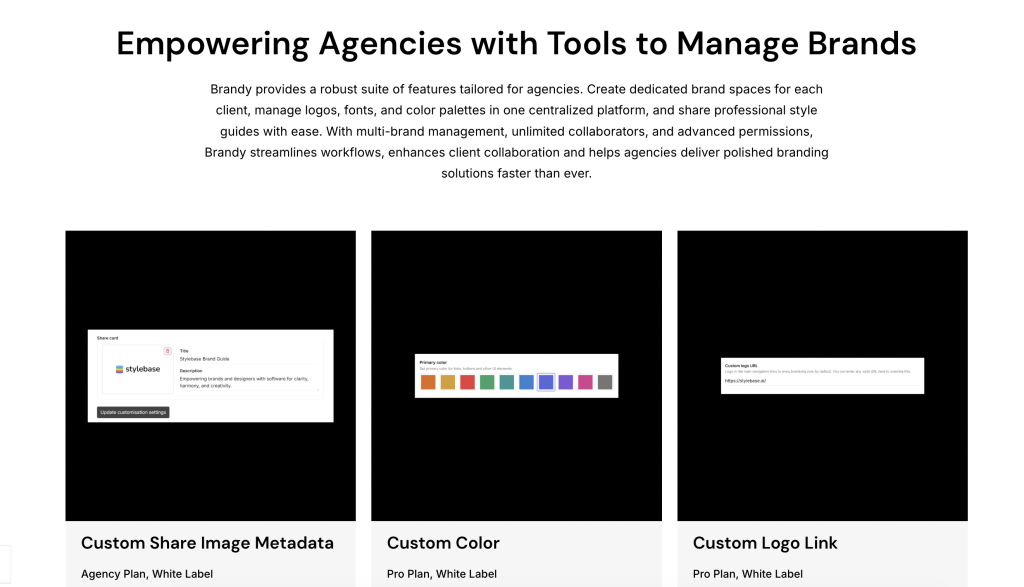
This is not possible with Google Drive. Sending a client a Google Drive link does nothing for your agency’s brand. Sending them a login to your branded brand management platform is a different experience entirely.
White-label brand management turns a service into a product. Agencies using BrandOS can offer brand management as a premium add-on to their existing client work.
Building a Recurring Revenue Stream
The white-label opportunity is not just about a presentation upgrade. It is a business model shift. When clients log in to a platform that carries your agency’s brand, they are not accessing a third-party tool you granted them access to. They are using your product.
That framing changes the commercial relationship. A client who pays monthly for access to your branded brand management platform is a retained client. The recurring revenue is predictable, the relationship is ongoing, and the switching cost for the client is meaningful. Google Drive cannot create this dynamic.
What BrandOS Includes
The BrandOS white-label plan gives agencies custom login portals, branded URLs for each client’s brand space, white-labeled email notifications, and the full Brandy feature set presented under the agency’s visual identity. We isolate each client account, control permissions with precision, and provide agencies with a centralized dashboard to manage all brands efficiently.
For agencies building a professional brand management practice rather than providing one-off design deliverables, BrandOS is the infrastructure that makes that practice scalable.
Free Plan Comparison: Google Drive vs Brandy
Google Drive pricing offers 15GB of unstructured storage on the free plan. It is useful for documents and backups, but it provides no brand management capabilities.
Brandy pricing includes a fully structured brand space with up to 20 brand assets, complete brand guidelines, and a shareable brand URL on the free plan. No credit card required.
For small teams and startups, Brandy’s free plan provides everything needed to create a professional brand presence from day one. Paid plans start at $50 per year for teams needing more assets or advanced features.
What the Free Plan Gives You
The Brandy free plan is not a limited preview. It is a fully functional brand space that covers the complete requirements of a small team or early-stage startup managing a single brand.
Upload your primary logo and its variants. Add your complete color palette with all values. Document your typography. Write your brand voice guidelines. Share the URL with your team and your external partners. All of this is available on the free plan, with no time limit and no credit card required.
The upgrade to a paid plan becomes relevant when you need more than 20 stored assets, when you are managing multiple brands, or when you need the access control and white-label features that agencies and growing teams require.
Ready to Manage Your Brand Properly?
Google Drive is a reliable file storage tool. For teams that need more than storage, Brandy provides the structure, the visual organization, and the professional presentation that brand management actually requires.
Start free today. Build your brand space in under 5 minutes, share a single URL with your team and partners, and see the difference between a folder and a dedicated brand platform.
Start Free · No credit card required. See Pricing
Frequently Asked Questions: Google Drive vs Brandy
You can store brand files in Google Drive, but it has no brand management features. Brandy is purpose-built for brand asset management with guidelines, a structured organization, and shareable brand URLs.
Yes. Brandy lets agencies manage unlimited client brand spaces, control permissions, white-label the platform, and share a clean brand URL with clients. See how brand management for agencies works in Brandy.
Yes. Brandy offers a free plan with up to 20 brand assets and full brand guidelines. No credit card required. See full Brandy pricing.
Yes. You can upload assets directly or use Brandy’s URL import feature. Most teams are set up within a day. Enterprise customers also get white-glove onboarding support.
Not entirely. Google Drive is useful for general document storage. Brandy specifically manages brand assets and is the best tool for anything brand-related.