
KFC just launched one of the most ambitious brand refreshes in fast food history. And the real story is not the new bucket design or the 20-sauce pantry.
It is the challenge of rolling out a completely updated visual identity, packaging, restaurant design, digital presence, and advertising simultaneously across 34,000 locations in more than 150 countries, with a new KFC opening somewhere in the world every 3.5 hours.
That is a brand management problem at a scale most teams will never face. But the lessons it surfaces apply to any brand operating across multiple locations, markets, or partners.
What KFC Actually Changed and Why It Matters?
KFC’s refresh spans menu innovation, restaurant design, beverage offerings, and visual identity, representing a comprehensive evolution that addresses changing consumer behaviors, increased competition, and shifting expectations for restaurant experiences.
The visual identity work was developed in partnership with global branding agency JKR. The project is a complete visual overhaul spanning packaging, digital platforms, advertising, and physical environments, designed to establish a cohesive global experience across more than 34,000 restaurants.
At the center is the bucket, KFC’s most recognizable asset, refreshed with new energy alongside a subtle evolution of the Colonel himself, ensuring the brand’s legacy remains front and center. The updated branding comes to life across packaging, digital platforms, advertising, and restaurant environments.
The rollout started in the UK and Ireland, with expansion expected to Australia and the US in the coming weeks, with additional markets following through 2026.
That sequenced, market-by-market rollout is not just a logistics decision. It is a brand consistency strategy. And it points directly to the biggest challenge in any global rebrand.
The Real Challenge: Getting 34,000 Locations to Show Up as One Brand
A rebrand at this scale is not a design project. It is a distribution and governance project.
Every packaging update, every new logo application, every refreshed in-store graphic needs to reach the right location in the right format at the right time. One outdated file circulating in a regional market undermines the entire refresh. One franchisee applying the old color palette to new signage creates a visible inconsistency that customers notice, even if they cannot name it.
This is the problem every multi-location brand faces when updating its brand, regardless of scale.
The assets have to go somewhere. They have to be the right version. And every location has to use the same source.
Three Brand Management Lessons From KFC’s Refresh
A refresh at this scale does not happen by accident. The way KFC is executing it reveals exactly what separates brands that stay consistent during a rebrand from those that spend months cleaning up the mess.
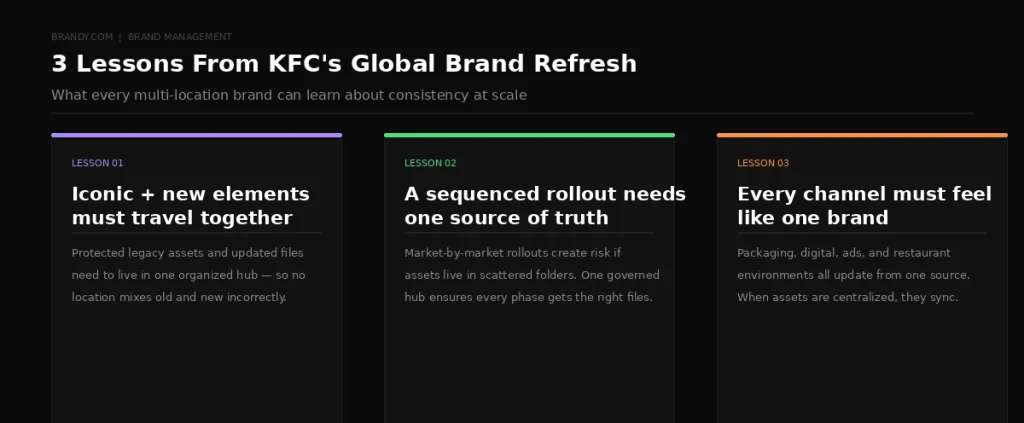
Lesson 1: Iconic Elements and New Elements Need to Travel Together
KFC kept what matters most, Colonel Sanders and the Finger Lickin’ Good slogan, while evolving everything around them. That decision protects the brand equity built over 74 years while creating space for the refresh to feel genuinely new.
For any brand managing a refresh, this is the hardest balance to strike in execution. The updated assets and the protected legacy elements need to be clearly separated, labeled, and distributed together so that no location mixes the old and the new.
When assets are centralized in a governed brand hub, that separation is built into the system. Approved updated files and protected legacy elements both live in one place, clearly organized, with no ambiguity about which version applies where.
Lesson 2: A Sequenced Rollout Only Works If Every Market Gets the Same Source
KFC’s rollout is deliberately phased. UK and Ireland first, then Australia and the US, then additional markets through 2026. This reduces the operational complexity of updating thousands of locations simultaneously.
But a phased rollout creates its own consistency risk. Markets that go live early are working from the new brand. Markets still in rollout are working from the old one. If assets live in scattered folders, email threads, or regional Drive links, the risk of cross-contamination increases with each phase.
A centralized brand hub solves this by design. Each market gets access to exactly the assets relevant to their phase of the rollout, with permission-based controls that ensure the right files reach the right teams at the right time.
Lesson 3: Packaging, Digital, and Physical Environments Must Feel Like One Brand
KFC is updating its visual identity across packaging, advertising, and digital platforms while retaining its signature bucket and Colonel Sanders branding. That coherence across every surface, physical packaging, restaurant environments, digital channels, and advertising, is what makes a rebrand feel complete rather than partial.
For most brands, the failure point is not the design. It is the distribution. The packaging update reaches retail before the digital assets are updated. The new logo goes live on social before the correct file reaches franchisees for print materials. Small timing gaps create visible inconsistency that the brand then spends months cleaning up.
When all assets live in one current, accessible hub, every channel updates from the same source. The brand shows up consistently because the system makes inconsistency structurally unlikely.
What Does This Mean for Brands That Are Not KFC?
You do not need 34,000 locations for this to be relevant. Any brand managing a refresh, update, or evolution across multiple locations, partners, or channels faces the same core problem at a smaller scale.
The assets need to be organized somewhere. Every team, franchisee, retailer, and partner needs to be working from the current version. Outdated files need to stop circulating as soon as the new ones are live.
Most brands handle this by sending updated files over email, updating a shared Drive folder, and hoping the message reaches everyone who needs it. It rarely does. Old versions keep circulating. Locations miss the memo. The brand looks different in different markets for longer than it should.
The brands that execute a refresh cleanly are the ones with a system underneath it, a centralized, governed place where every asset lives, every version is controlled, and every team can find exactly what they need without asking.
How Brandy Supports a Brand Refresh at Any Scale
Brandy is built to be the centralized brand hub that enables a clean rollout, whether you are managing 10 locations or 10,000.
What Brandy gives brand teams during a refresh:
- Brand spaces that can be organized by market, phase, or location, so each team sees exactly what is relevant to them
- Shareable brand kits that give every franchisee, partner, and regional team the current assets in one link that updates automatically
- Version snapshotting so the new brand assets are always front and center, and the old versions are archived, not deleted, and not circulating
- Permission-based access, so markets in different rollout phases get the right files at the right time without confusion
- Advanced tagging and metadata so anyone on the team finds the right asset in seconds during the most time-pressured phase of a launch
- Support for 30-plus file formats with built-in conversion, so every asset arrives in the format each location actually needs
- SOC 2 Type II compliance for enterprise-grade security across the entire asset library
A brand refresh is only as clean as the system behind it. When every team is pulling from the same current, organized, permission-controlled source, the brand shows up consistently from day one of the rollout.
The Takeaway
KFC’s global refresh is a reminder that the hardest part of any rebrand is not the design. It is the execution across every location, every channel, and every partner that carries the brand.
For brands at any scale, that execution depends on one thing: a single, governed place where the right assets live and every team knows exactly where to find them.
Brandy is built to be that place. Start for free at brandyhq.com.