
Looking for the best brand guidelines examples to inspire your next big rebrand or tighten up your design system? You’re in the right place. We’ve curated 24 of the most strategic, creative, and practical brand books that industry leaders are using today — from tech giants to digital-first disruptors.
These aren’t your average PDF brand manuals. We’re talking about dynamic, web-based hubs full of downloadable assets, voice and tone playbooks, UI kits, and real-life brand usage examples. Whether you’re building a startup brand from scratch or modernizing a legacy identity, these examples will give you a crystal-clear roadmap.
Explore this list to:
- Steal ideas for your own brand documentation
- See how top brands maintain consistency across platforms
- Discover what elements make a great modern style guide
✅ Bonus: These 25 are just the beginning. Dive into our Top 100 Brands list for more examples from global leaders.
What Makes a Great Brand Guideline?
Before we jump into the list, here’s what separates the good from the great:
- Accessible: No more dusty PDFs — modern brand guidelines live online.
- Practical: They show how to use brand elements, not just what they are.
- Collaborative: Easy for teams, partners, and agencies to navigate and apply.
- Comprehensive: Covers everything from mission to motion.
Top 23 Brand Guidelines Examples
Discover how the world’s most influential brands document their identity, streamline collaboration, and scale brand consistency. These examples are handpicked to inspire your next brand book — whether you’re rebranding or starting from scratch.
1. TikTok

TikTok’s brand guidelines are more than just a repository of assets — they’re a living framework for global content creators, influencers, and marketers. By combining motion, sound, and platform-specific usage rules, TikTok ensures its brand stays fun yet consistent in every swipe.
Why we love these brand guidelines:
- Downloadable assets directly from the page.
- App-specific content guidelines for creators.
- Detailed co-branding rules for marketers.
2. Dropbox
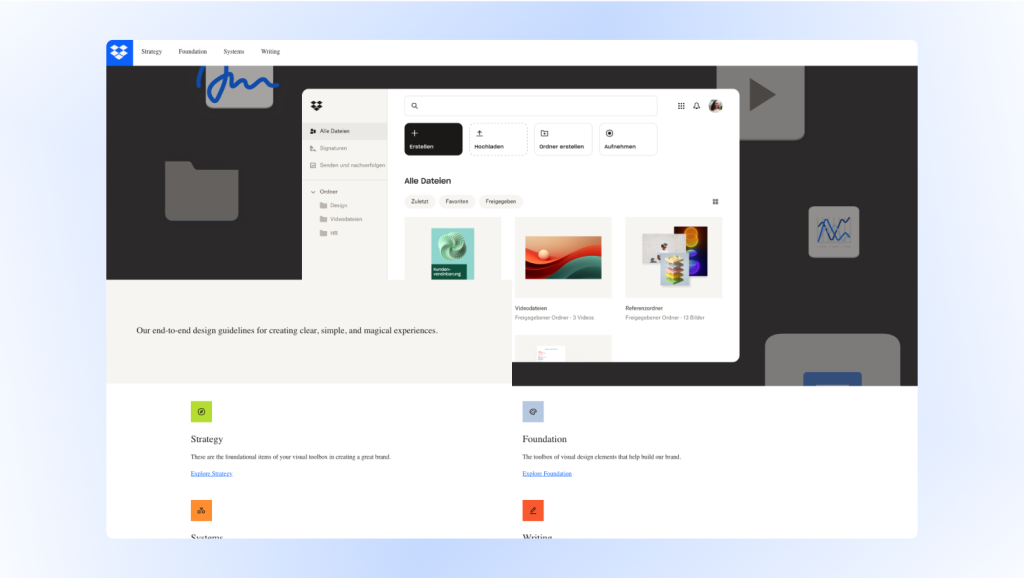
Dropbox’s guidelines reflect its modern brand identity, with a detailed system that aligns tone, visuals, and functionality for seamless user experience. These brand guidelines stand out for their unique approach to managing identity and ensuring consistency across every touchpoint.
Why we love these brand guidelines:
- Covers strategy, tone, visuals, and design system.
- Voice-and-tone section enhances brand consistency.
- Design system links help UX/UI teams implement faster.
3. Netflix

Netflix takes a governance-first approach to branding — their guide is built for clarity and control, especially in co-branded scenarios. It blends sleek use-case visuals with permission-based access to core identity assets.
Why we love these brand guidelines:
- Selective access to maintain brand governance.
- Clear logo usage examples and restrictions.
- Well-structured co-branding partnership guidelines.
4. Mailchimp

Mailchimp’s branding rules are unapologetically fun. Their playful tone is matched with expressive illustrations and character-driven layouts — a standout approach that transforms every communication into brand storytelling.
Why we love these brand guidelines:
- Playful visual tone that matches brand personality.
- Illustration and typography reflect the brand voice.
- Custom components for campaigns and brand storytelling.
5. Spotify

Spotify’s design language pulses with rhythm and clarity. Whether it’s motion behavior, sound iconography, or app interface alignment — their guide turns brand expression into a multisensory journey.
Why we love these brand guidelines:
- Focuses on motion design and accessibility.
- Brand guidelines integrate audio and digital identity.
- Supports app-wide and partner branding consistency.
6. Mastercard
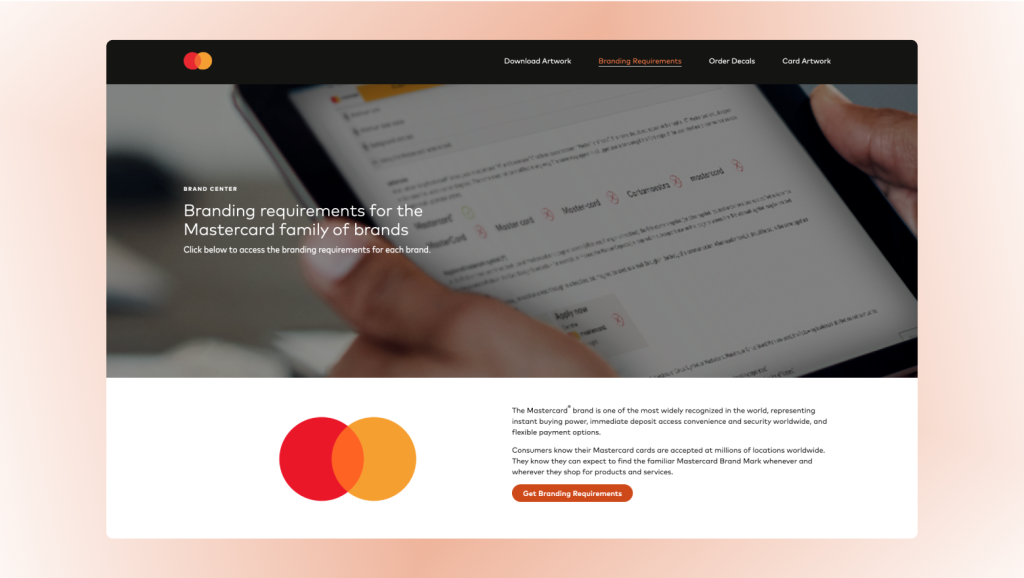
Mastercard modernized its identity by stripping complexity and doubling down on iconography. Their brand guidelines showcase how to maintain timeless recognition across digital ecosystems.
Why we love these brand guidelines:
- Simple, modern interface for global usage.
- Downloadable artwork in multiple formats.
- Real-time updates and FAQs to aid users.
7. Instagram

Instagram’s brand standards are a masterclass in gradient control and typography nuance. From font previews to layout experiments, everything feels built for visual fluency across mobile and content-first platforms.
Why we love these brand guidelines:
- Editable previews for fonts and gradients.
- Comprehensive permission request section.
- Clear color pairing guidance for visual brand consistency.
8. Google

Google’s Material Design isn’t just a style guide — it’s a design philosophy. With deep component libraries, adaptive layout principles, and accessibility baked in, it redefines how brand meets product.
Why we love these brand guidelines:
- Material Design is open-source and community-backed.
- Extensive design tokens and reusable UI elements.
- Supports developers and product designers globally.
9. Starbucks

Starbucks brings brand warmth to life through heritage-driven visuals and mission-led messaging. Its guide blends lifestyle imagery, retail cues, and campaign samples to drive emotional storytelling.
Why we love these brand guidelines:
- Philosophy-first approach to branding.
- Case studies from global campaigns included.
- Offers editable templates for brand rollouts.
10. Uber

Uber’s brand system is engineered for scale. With minimalist color logic, modular components, and voice consistency across apps and ads, it’s branding that moves with precision.
Why we love these brand guidelines:
- Highly modular system for global teams.
- Strong emphasis on tone, motion, and iconography.
- Supports branding across digital and print channels.
Additional Examples from Leading Brands to Inspire
11. Figma
Figma’s brand guidelines blend open design with structured rules, showcasing how collaborative tools can shape a unified visual identity.
Why we love these brand guidelines:
- Open-source design tokens with consistent visual rules.
- Includes tone-of-voice and branding usage examples.
- Built by designers, for designers — intuitive and modern.
12. Canva
Canva simplifies branding for the masses with easy-to-follow guidelines that empower creators to maintain brand integrity.
Why we love these brand guidelines:
- Clear partnership and logo usage instructions.
- Online assets for quick access and edits.
- User-friendly layout supports non-designers too.
13. DevRev
DevRev’s visual identity guide is a masterclass in minimalism meets practicality. Their brand portal serves not just as a guideline hub, but as a learning resource that enables faster brand onboarding and frictionless creative execution.
Why we love these brand guidelines:
- Quick download option: Users can click a single button to download all of DevRev’s brand assets in one go. Perfect for busy creatives.
- In-use examples: The guidelines contain a gallery of brand materials to see how the elements work together to create a cohesive visual identity.
- Simple navigation: The collapsible navigation lets you jump between the sections of the guidelines quickly so you can easily find the elements and resources you need.
14. Hulu
The Hulu brand guidelines are a standout example of modern brand governance, offering clarity, consistency, and accessibility across digital and physical touchpoints.
Why we love these brand guidelines:
- AV branding support — a must for streaming brands.
- Downloadable icons and logos in various formats.
- Print-ready color palettes for offline assets.
15. IBM
IBM’s brand guide weaves tradition with innovation, offering detailed standards for visual storytelling and data representation.
Why we love these brand guidelines:
- Dedicated ‘what’s new’ section to track changes.
- Data visualization standards ensure clarity and impact.
- Downloadable toolkits for Adobe, Sketch, and more.
16. Trustpilot
Trustpilot’s guide prioritizes credibility, giving users localization tools and co-branding rules to amplify user-generated trust.
Why we love these brand guidelines:
- Local market adaptation through localization guides.
- Library of brand assets including sub-brand files.
- Detailed co-branding support for partners and affiliates.
17. Apple
Apple’s HIG is the gold standard for precision and minimalism, balancing function with elegant brand presentation.
Why we love the Apple’s brand guidelines:
- Human Interface Guidelines are industry benchmarks.
- Pixel-perfect specs for icons and interface design.
- Minimalist style with rigorous visual logic.
18. Airbnb
Airbnb’s guide channels the spirit of belonging, using narrative and design to connect global communities through cohesive branding.
Why we love the Airbnb’s brand guidelines:
- Emotional storytelling built into visual rules.
- Custom illustrations and type treatments.
- Inspires consistent brand experience across cultures.
19. Klarna
Klarna takes a bold approach with scrollable storytelling, mixing vibrant visuals and tonal clarity for a fintech edge.
Why we love Klarna’s brand guidelines:
- Scrollable brand hub with past campaigns.
- Side-by-side voice examples show brand tone in action.
- Highly intuitive layout for quick navigation.
20. Mozilla Firefox
Mozilla Firefox brand guide doubles as a community-driven design manifesto. Every element — from HEX values to illustration style — is shared transparently, encouraging open collaboration while preserving its core brand values.
Why we love these brand guidelines:
- Instant access to core brand assets and icons.
- Copyable color codes for developers and designers.
- Do’s and don’ts guide maintain brand clarity.
21. Beyond Gravity
Beyond Gravity builds sensory-rich branding, blending sound, material textures, and visuals to craft a multidimensional identity.
Why we love Beyond Gravity brand guidelines:
- Includes multisensory branding like sound and texture.
- Image editing and formatting advice for brand style.
- Voice-and-tone tips for employee communications.
22. Nike
Nike’s internal brand systems are tightly controlled and trendsetting, blending minimalism with powerful storytelling in every element.
Why we love Nike’s brand guidelines:
- Although private, their brand decks set trends.
- Universal consistency across retail, digital, and social.
- Simple yet powerful identity rules.
23. Twitch
Twitch’s guide celebrates community energy, using vibrant design elements to reflect its streamer-first, digital-native audience.
Why we love Twitch brand guidelines:
- Reflects the energy of its gamer-first community.
- Loud color usage and playful type guidance.
- Flexible branding for creators and streamers
Why Brand Guidelines Are No Longer Optional
A brand isn’t just a logo or a typeface — it’s an experience. And without clear brand guidelines, your identity can quickly become diluted across marketing campaigns, partner usage, and internal teams.
These 25 brands prove that brand consistency can scale globally with the right documentation in place. Digital guidelines make it easier to share, update, and collaborate across departments and time zones.
So whether you’re a brand manager, designer, or agency partner — let this blog serve as your blueprint.
Want to Build Brand Guidelines Like These?
Try Brandy — the all-in-one platform to create, store, and share dynamic brand guidelines. No more outdated PDFs or disorganized Google Drive folders. Brandy helps you:
- Upload and manage approved brand assets
- Create editable, web-based brand books
- Collaborate with teams and clients
Start your free trial today and see how simple brand consistency can be.