For years, the go-to format for sharing brand guidelines has been a simple PDF. It feels convenient, easy to attach in an email, and gives the impression of a polished, final document. Yet anyone who has tried to manage brand assets this way knows how quickly a PDF becomes outdated. The moment your logo changes, your color palette shifts, or you update your typography, that polished file no longer reflects your brand accurately.
This is where the shift begins. Modern brands are realizing that a PDF, while useful as a one-time handout, cannot keep up with the demands of fast-moving teams and global collaboration. Brand consistency today requires a living space, not a static document. That is why platforms like Brandy are changing the way organizations think about brand guidelines.
In this article, we will explore why many companies still rely on PDFs, the challenges they face with that approach, and how Brandy offers a more flexible, scalable, and user-friendly solution for managing brand identity.
Why Companies Still Use PDFs for Brand Guidelines
Even with all the new tools available today, many companies continue to rely on PDFs for their brand guidelines. Part of this comes down to habit. PDFs have been around for decades, and teams are comfortable using them. Creating a PDF feels straightforward: design the document once, export it, and share it with colleagues or external partners.
Another reason is perception. A PDF looks finished, professional, and easy to send in an email or upload to a shared folder. For small businesses or teams that do not update their branding often, this method may feel like enough. It offers a sense of control because once the file is created, nothing changes unless a new version is made.
There is also the factor of cost. Many organizations believe that sticking to a PDF is the simplest and cheapest way to distribute their guidelines. They see it as a one-time job that requires no ongoing investment.
While these reasons explain why PDFs are still in use, they also highlight the limitations of this format in today’s digital-first environment. As we will see in the next section, what once felt like a strength is now often a weakness for teams who want agility, consistency, and ease of collaboration.
Limitations of Managing Brand Assets with PDF
On the surface, PDFs seem reliable, but once you dig deeper, the cracks start to show. The biggest challenge is that they are static. The moment your brand evolves, that PDF is out of date. You end up with multiple versions floating around in email threads, shared drives, or partner folders, and no one can be sure which one is the latest.
Version control becomes a real headache. A designer might use an old color palette from a PDF they downloaded months ago, while the marketing team works with an updated logo hidden in another file. This inconsistency not only wastes time but also weakens your brand identity in the eyes of customers.
Accessibility is another major issue. PDFs are easy to share but not easy to navigate. Imagine a new team member trying to find the right font guidelines buried on page 32. Without interactive search or a clear structure, they spend more time hunting than creating.
Then there is the lack of flexibility. You cannot embed videos, clickable examples, or live links to your latest assets inside a PDF in a way that truly works. At best, you get a static reference point. At worst, people ignore it altogether because it feels too heavy to use.
These limitations show why more and more teams are looking for alternatives that go beyond a simple document. That is where Brandy steps in with a completely different approach.
What Brandy Brings to the Table
Brandy transforms brand management from a static document into an interactive, living portal. Here are the key ways it outshines PDFs:
- Centralized brand portal
All your logos, fonts, templates, and guidelines live in one place, ensuring teams and partners always access the same source of truth. - Instant updates
Any change made to brand assets or guidelines is reflected immediately across the portal. No need to resend or re-download files. - Interactive experience
Users can search, filter, and navigate quickly to find exactly what they need. This makes it far more practical than scrolling through pages of a PDF. - Seamless integration with workflows
Brandy connects easily with the tools creative and marketing teams already use, helping them work faster without switching contexts. - Scalability for growing brands
From startups to global organizations, Brandy supports teams of all sizes with permissions, asset organization, and multi-market management.
In essence, Brandy is more than just a guideline tool. It provides a dynamic brand hub that keeps everything consistent, accessible, and up to date.
Brandy vs PDF: Side by Side Comparison
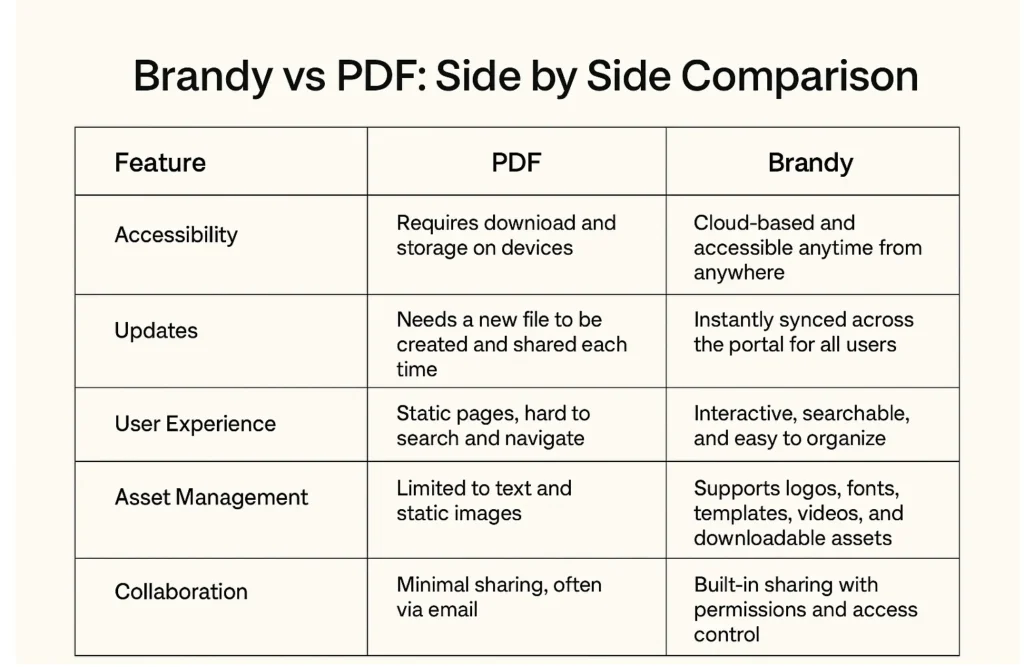
To see the difference clearly, let us compare PDFs and Brandy feature by feature.
| Feature | Brandy | |
| Accessibility | Requires download and storage on devices | Cloud based and accessible anytime from anywhere |
| Updates | Needs a new file to be created and shared each time | Instantly synced across the portal for all users |
| User Experience | Static pages, hard to search and navigate | Interactive, searchable, and easy to organize |
| Asset Management | Limited to text and static images | Supports logos, fonts, templates, videos, and downloadable assets |
| Collaboration | Minimal sharing, often via email | Built in sharing with permissions and access control |
Why Brandy Wins
- Brandy removes the version control issues that plague PDFs by acting as a single source of truth.
- Teams can move faster because they always know where to find the latest files.
- The experience is dynamic, allowing navigation, search, and filtering instead of endless scrolling.
- Global collaboration becomes simpler since external partners and agencies can be given secure access without juggling multiple PDFs.
In short, while PDFs may have been the standard for years, Brandy is designed for the realities of modern branding where speed, consistency, and collaboration matter most.
How Teams Benefit from Switching to Brandy
Switching from a static PDF to Brandy creates real advantages for every part of the organization. Here is how different teams benefit:
- Marketing Teams
No more delays or confusion when preparing campaigns. They can instantly access the right logo, colors, and templates without waiting for designers to resend files. - Designers
Instead of fielding constant requests for assets, designers can focus on creative work knowing that Brandy provides everyone with the latest versions. - Agencies and Partners
External collaborators no longer have to rely on outdated PDFs. With Brandy, they always work with the most current assets and guidelines, which reduces mistakes and back-and-forth communication. - Leadership and Brand Managers
Brand consistency is easier to enforce across regions, markets, and teams. Leaders have confidence that every touchpoint, from social media to packaging, reflects the brand accurately.
By moving to Brandy, organizations save time, cut down on errors, and ensure that their brand is always presented in the best possible way.
Real World Use Cases: PDF vs Brandy in Action
To understand the difference, let’s look at how teams actually experience PDFs compared to Brandy.
- A Startup Using PDFs
A small startup creates a polished PDF to share its brand guidelines. At first, it worked fine. But as the company grows and updates its visuals, multiple versions of the PDF start floating around. Some employees use the old logo, others stick to outdated colors, and partners get confused about which assets are correct. The result is inconsistent branding and wasted time hunting for the latest file. - A Global Company Using Brandy
A large international brand manages dozens of teams across different markets. Instead of relying on PDFs, they use Brandy as their central brand kit. Whenever guidelines are updated, the changes appear instantly for everyone, no matter where they are. Agencies, partners, and regional offices always access the latest assets. This creates consistency worldwide and eliminates the chaos of version control.
These two examples highlight a simple truth. PDFs may be enough at the start, but as soon as a brand grows, they quickly fall short. Brandy gives teams the reliability, speed, and clarity they need to stay aligned.
Future of Brand Guidelines: Why PDFs Will Fade
The way companies manage their brands is evolving. Static documents like PDFs once felt like the only option, but in a digital world that moves quickly, they no longer keep up. As businesses expand across regions, platforms, and audiences, the need for flexibility and instant updates becomes essential.
Cloud based brand portals like Brandy are leading this shift. They make it possible to maintain one single source of truth, update assets in real time, and provide an interactive experience that a static PDF can never match. Teams are no longer satisfied with downloading a file and hoping it is the right version. They want tools that adapt as fast as their brand does.
Looking ahead, it is clear that the future of brand guidelines belongs to dynamic platforms. PDFs will not disappear overnight, but their role will shrink as more organizations adopt living systems like Brandy to keep their brand consistent, accessible, and ready for growth.
Conclusion
For years, PDFs were the default way to share brand guidelines. They offered a simple solution, but as brands grow and evolve, the cracks in that method become obvious. Static documents cannot keep pace with real time changes, and version control quickly turns into a frustrating problem.
Brandy steps in as the smarter alternative. By giving teams a central hub that is always up to date, it removes confusion, saves time, and ensures brand consistency across every channel. From designers and marketers to agencies and leadership, everyone benefits from having a single source of truth.
The future of brand management lies in tools that are interactive, flexible, and built for collaboration. PDFs may have played their part, but platforms like Brandy show us what brand guidelines should look like in a modern world.