
Canva is a graphic design tool used to create visuals. Brandy is a brand asset management platform that stores, organizes, and governs brand assets. Many teams use both: Canva to create, Brandy to manage, and share. For agencies needing brand governance, white labeling, and multi-brand management, Brandy is the dedicated solution.
Brandy vs Canva: Feature Comparison
| Feature | Canva | Brandy |
|---|---|---|
| Purpose | Design creation tool | Brand asset management |
| Brand guidelines | Basic Brand Kit only | Full guidelines pages |
| White label | Canva for Teams only | Yes: BrandOS plan |
| Multi-brand management | Limited by plan | Unlimited brand spaces |
| Asset storage | Canva-format assets | 30+ file formats |
| External sharing | Canva links | Public brand space URL |
| Permissions | Team-level | Role-based access control |
| AI features | Magic Studio (design AI) | AI brand consciousness |
| File export control | Limited | Full control per asset |
| Free plan | Yes: limited features | Yes: 20 brand assets + full guidelines |
Canva vs Brandy: Different Tools for Different Jobs
Canva and Brandy are not direct competitors. They solve different problems, and understanding that distinction helps you get the most out of both.
Canva is a design creation tool. It is excellent for building social media graphics, presentations, flyers, and marketing materials. Its drag-and-drop interface makes design accessible to non-designers, and its template library speeds up content production.
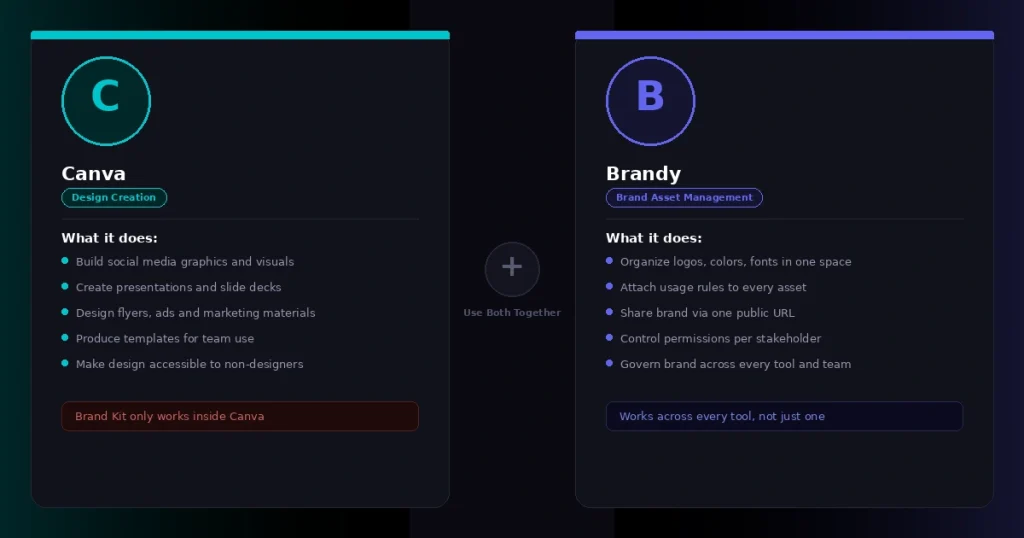
Brandy is a brand asset management platform. It is built to store, organize, govern, and share the brand assets your team creates, wherever they were created, including Canva.
Many of the best-run agencies and brand teams use both: Canva to create, Brandy to manage. This combination gives teams the speed of Canva’s design tools and the governance of Brandy’s brand management platform.
Why the Distinction Matters for Agencies
The mistake most agencies make is treating Brand Kit as brand management. It is not. Brand Kit is a design convenience feature. It keeps colors and fonts consistent inside Canva templates. It does nothing for the vendor who needs a logo file, the client who wants to review their brand guidelines, or the new hire who needs to understand the brand before their first campaign.
Brand management is the infrastructure that connects every use of a brand, across every tool, every team, and every stakeholder. Canva’s job is to make design faster. Brandy’s job is to make brand management reliable.
What This Means in Practice
A team using Canva without Brandy has fast design and fragile governance. Every asset created in Canva lives in Canva. It cannot be accessed by a developer, a print vendor, a PR agency, or a new team member without a Canva account and access to the right workspace.
A team using both has fast design and solid governance. Assets are created in Canva, exported, and brought into Brandy, where they become part of a structured brand space accessible to anyone with the URL.
Start Free · Free plan available, no credit card required.
Why Brandy is Better for Brand Governance
Canva’s Brand Kit is a useful feature for keeping colors and fonts consistent within Canva designs. It allows teams to set brand colors, upload fonts, and save logos for use in Canva templates.
But it only works inside Canva.
When a team member opens Figma, Photoshop, or a PowerPoint template, Canva’s Brand Kit provides no governance. Vendors cannot rely on a Canva Brand Kit link for complete brand guidelines, and new employees still lack a single source of truth that works across every tool they use.
Brandy creates brand governance that works everywhere. Your brand space is a standalone URL that anyone can access, no Canva account required. It covers every aspect of your brand identity, not just the assets used in a single design tool.
The Single Source of Truth Problem
The fundamental gap between Canva Brand Kit and a dedicated brand management platform is what happens outside Canva. Brand Kit solves a narrow problem well: keeping designs consistent within a single tool. The moment brand governance needs to extend beyond that tool, Brand Kit is not the answer.
A brand space in Brandy is accessible to any stakeholder regardless of what tools they use. A developer building a website gets the SVG logo and hex codes. A print vendor gets the CMYK values and high-resolution files. An agency partner gets the brand guidelines. All of this happens through one URL that the brand manager controls.
Guidelines Attached to Assets
The most important structural difference between Canva Brand Kit and Brandy is that Brandy attaches guidelines to assets. A logo in Brandy comes with usage notes: when to use the dark version, the minimum size, approved backgrounds, and what must never be done with it.
A logo in Canva Brand Kit is a file in a template library. The guidelines, if they exist at all, live in a separate document that most people never read. That disconnection is the root cause of most brand consistency failures in growing teams.
White Label and Agency Use
Agencies managing client brands need more than Canva’s multi-brand features. Canva for Teams supports multiple brands, but it remains a Canva-branded experience. Clients see Canva, not your agency.
Brandy’s BrandOS white-label brand management plan changes that. Agencies can present a fully branded brand management platform to clients: custom login portals, custom URLs, and branded email invites. Clients experience your agency’s platform, not a third-party tool.
This positioning transforms how agencies deliver brand management. Instead of a service, it becomes a product. Agencies using BrandOS can charge for platform access, build recurring revenue, and differentiate from competitors who are still sending clients Google Drive links.
What White Label Changes for Client Relationships
When a client logs into a platform that carries your agency’s brand, the relationship changes. They are not accessing a tool you gave them access to. They are using your product. That framing creates a fundamentally different commercial dynamic, one where the agency is the custodian of the client’s brand identity rather than a vendor completing a project.
Canva cannot create this dynamic. A client accessing their brand through Canva is a Canva user who happens to work with your agency. A client accessing their brand through your white-labeled Brandy platform is a client of your brand management service.
Building Recurring Revenue from Brand Management
White-label brand management through BrandOS gives agencies a product they can sell on a recurring basis. Set a monthly platform fee, include brand space maintenance as a retainer component, and let the platform itself justify the ongoing relationship.
The agencies seeing the strongest ROI from Brandy are those that positioned it as a client-facing deliverable from day one, not as an internal tool they happen to use. Clients who understand that their brand lives in a dedicated, professionally maintained platform are significantly more likely to continue the relationship beyond the initial brand project.
Multi-Brand Management for Agencies
Agencies managing 10, 20, or 50 client brands face a scalability challenge with Canva. Multi-brand support in Canva is limited by plan tiers, and even at the highest tier, it is primarily designed to keep design templates organized, not to govern brand assets across clients.
Brandy provides brand management for agencies, with unlimited brand spaces from day one. Each client has a dedicated brand environment. Switching between clients is instant. Sharing a client’s brand assets means sending one URL. Permissions are controlled at the brand space level, so clients only see their own assets.
For agencies doing brand management at scale, Brandy is the operational backbone that Canva was not built to be.
Scaling Without Per-Client Overhead
The operational burden of managing multiple client brands in Canva grows with every new client. New workspace configurations, new Brand Kit setups, new permission structures, and new template libraries. Each client adds overhead that does not decrease as the agency scales.
In Brandy, adding a new client brand space takes minutes. The structure is the same every time. Permissions follow the same pattern. The URL is generated automatically. The onboarding overhead per new client is minimal, meaning the agency can take on more clients without proportional increases in operational effort.
Client Isolation and Confidentiality
In Canva, properly isolating client assets requires careful workspace management. Mistakes happen. Templates from one client appear in another’s workspace. Assets are stored in shared folders with broader access than intended.
Brandy’s brand spaces are structurally isolated. Each client’s assets, guidelines, and permissions exist in a completely separate environment. There is no possibility of one client accessing another’s materials, and the agency controls exactly who sees what within each space.
Use Canva and Brandy Together
The best workflow for agencies and brand teams is to use Canva and Brandy together, each doing what it does best.
Use Canva to create designs, build templates, and produce marketing materials. When assets are finalized, export them from Canva and bring them into Brandy. In Brandy, they live in your brand space alongside your logos, colors, fonts, and guidelines: organized, versioned, and shareable.
Your team gets the speed of Canva’s design tools and the governance of Brandy’s brand management platform. Your clients get a professional brand space with their complete brand identity, not a folder of Canva exports.
The Workflow in Practice
The handoff from Canva to Brandy takes minutes and happens once per asset. Finalize the design in Canva. Export in the required formats. Upload to the relevant Brandy brand space. Add usage notes. The asset is now part of the governed brand library, accessible to all stakeholders who need it, with no ongoing maintenance required unless the asset changes.
This workflow is additive, not disruptive. Teams do not stop using Canva. They continue creating in Canva exactly as before. What changes is that the output of that process has a proper home, and the people who need those assets can find them without asking anyone.
What to Keep in Canva vs What to Move to Brandy
Not every Canva file needs to live in Brandy. Working files, drafts, and in-progress campaign materials stay in Canva. What moves to Brandy is the final, approved version of any asset that will be used by more than one person or shared outside the core design team.
Logos, final color-corrected photography, approved templates, brand guidelines, and any asset that a vendor, client, or partner might need: these belong in Brandy. In-progress work, design experiments, and internal-only documents: these stay in Canva.
Already Using Canva? Bring Your Brand Assets into Brandy.
Canva makes design fast. Brandy makes brand governance reliable. The two tools work better together than either does alone, and getting started with Brandy alongside your existing Canva workflow takes less than five minutes.
Build your brand guidelines today. Give your team, clients, and partners a single source of truth for your brand that works across every tool, channel, and stakeholder.
Frequently Asked Questions: Canva vs Brandy
No. Canva is a design creation tool. Brandy is a brand asset management platform. Canva’s Brand Kit only works within Canva. Brandy governs your brand across all tools and teams.
Yes, they complement each other. Use Canva to create designs and Brandy to store, organize, and share your brand assets and guidelines with your full team.
Yes. Brandy offers a free plan with up to 20 brand assets and full brand guidelines. No credit card required. View Brandy pricing for full plan details.
Yes. Brandy’s BrandOS plan lets agencies white-label brand management with custom login portals, URLs, and branded email invites. Canva does not offer an equivalent.
Yes. Export your Canva assets and upload them to Brandy. Most teams are set up within a day. Enterprise customers also get white-glove onboarding support.
Canva pricing starts with a free plan for individuals and scales to team and enterprise plans. Brandy’s free plan includes 20 brand assets and full guidelines. Paid plans start at $50 per year. The two tools serve different functions, and most agencies find value in using both.