
Brand Management Blog & Resources
Hospitality has always been about experience. Long before a guest walks into a hotel lobby, books a table, or attends an event, they form opinions based on what they see online. Property photos, menus, videos, reviews, social media posts, and promotional campaigns shape expectations and influence decisions. In today’s digital first world, these materials are just as important as the physical experience itself.
Behind the scenes, hospitality teams manage a massive and constantly growing collection of digital assets. These assets change frequently due to seasonal offers, pricing updates, renovations, new menus, and location specific campaigns. When these files are scattered across folders, drives, emails, and agencies, teams struggle to stay consistent and responsive.
This is where digital asset management becomes critical. A well structured digital asset manager gives hospitality brands control, visibility, and confidence in how their content is used. Instead of slowing teams down, it creates clarity and consistency across every guest touchpoint. For hospitality brands that want to scale while protecting their reputation, digital asset management is no longer optional.
What Digital Assets Look Like in the Hospitality Industry
Digital assets in hospitality go far beyond photos and videos. Every piece of content used to communicate with guests or partners counts as a digital asset.
These include hotel room images, property walkthrough videos, restaurant menus, food photography, event brochures, social media creatives, email campaign visuals, influencer content, guest generated photos, brand logos, typography, design templates, and brand guidelines. It also includes operational materials such as signage, presentation decks, vendor kits, and promotional toolkits.
Hospitality brands produce more assets than most industries because experiences change constantly. A seasonal menu, a festival event, a renovated room, or a new destination offering all require fresh content. When these assets are not managed properly, teams risk using outdated or inconsistent materials that weaken trust.
Why Asset Sprawl Is a Growing Problem for Hospitality Teams
Asset sprawl happens when digital content lives in too many places without structure or ownership. One team saves files on a shared drive, another uses personal folders, agencies store assets externally, and vendors request files repeatedly.
As hospitality brands grow, this problem intensifies. Multi location operations often duplicate work because teams cannot find what already exists. A marketing manager may recreate visuals simply because they cannot locate approved versions. This leads to wasted time, unnecessary costs, and inconsistent branding.
Asset sprawl also slows decision making. When teams cannot quickly access accurate and approved materials, campaigns are delayed and opportunities are missed. In an industry where timing matters, this lack of visibility becomes a competitive disadvantage.
The Real Cost of Poor Asset Management on Guest Experience
Poor asset management directly impacts how guests perceive a brand. When a hotel website shows outdated room photos or a restaurant menu online does not match the in store offering, trust erodes instantly.
Guests expect consistency across channels. They want the same experience on booking platforms, social media, websites, and onsite. When assets are misaligned, guests feel confused or misled, even if the issue is unintentional.
Personalization also suffers. Hospitality brands know that tailored experiences drive loyalty and higher spending. Without organized assets, delivering personalized content at scale becomes nearly impossible. The cost is not just operational inefficiency but lost revenue and weakened brand reputation.
How Hospitality Teams Manage Assets Today and Where It Breaks
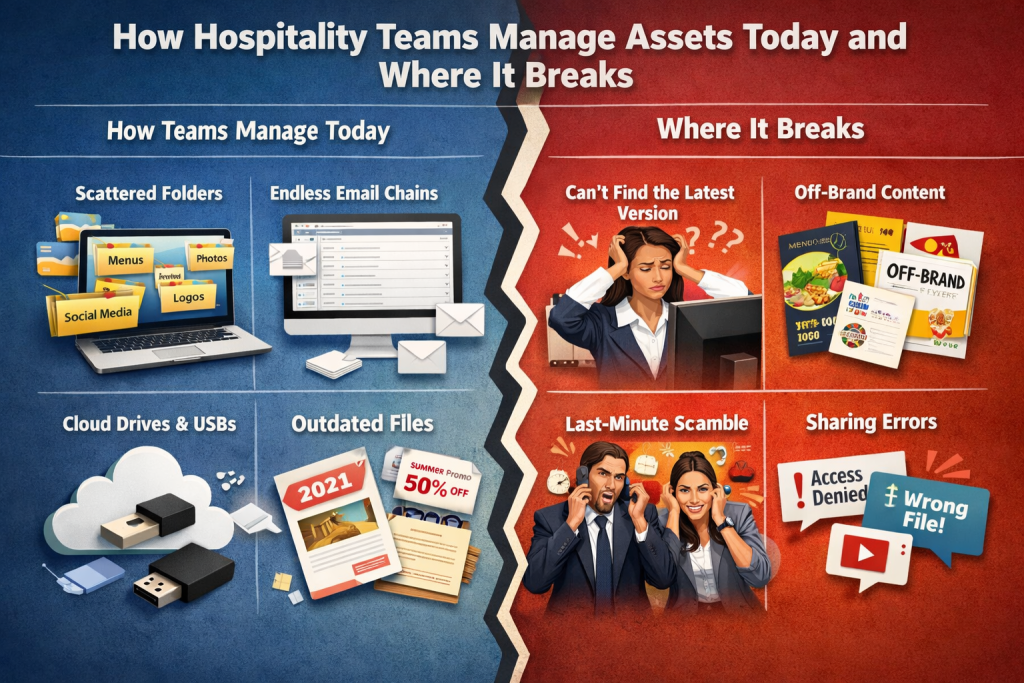
Most hospitality teams rely on familiar tools and improvised workflows to manage their digital assets. While these methods may work temporarily, they begin to fail as asset volume, teams, and locations grow.
Shared Drives and Cloud Folders
Many hospitality teams rely on tools like shared drives or basic cloud storage. While these tools centralize files to some extent, they lack structure, context, and control. Finding the right version often depends on knowing where to look or who created it.
Emails and Messaging Apps
Assets are frequently shared through email attachments or messaging platforms. This creates multiple versions with no clear source of truth. Once files leave the original folder, control is lost.
Agency and Vendor Storage
Agencies and vendors often store assets externally. Over time, hospitality teams lose visibility into what is being used, updated, or approved. This leads to brand drift and security risks.
These methods may work for small teams but they quickly break as brands scale.
What a Hospitality Ready Digital Asset Manager Should Actually Do
A digital asset manager designed for hospitality must do more than store files. It should act as a central system of record for all brand content.
Key capabilities include centralized storage, clear version control, searchable metadata, role based permissions, fast sharing, and brand governance. Teams should be able to find assets by property, location, campaign, season, or asset type without guessing.
Ease of use is critical. Hospitality teams include marketers, operators, partners, and vendors who may not be technically trained. A DAM should simplify workflows rather than introduce complexity.
Most importantly, it should scale with the business, supporting new locations, brands, and partners without breaking structure.
Using Digital Asset Management for Hotels and Resorts
Hotels and resorts rely heavily on visual and brand driven content to attract guests and drive bookings. From property images to promotional campaigns, every asset must stay accurate, consistent, and easy to access across teams and partners. Digital asset management helps hotel brands stay in control while scaling their operations smoothly.
Managing Property Images and Videos at Scale
High quality images and videos play a major role in booking decisions. A digital asset manager allows hotel teams to store all approved visuals in one centralized space. Assets can be organized by property, room type, location, season, or campaign, making it easy to find the right content quickly. This prevents outdated or incorrect visuals from appearing on websites, booking platforms, or marketing campaigns.
Maintaining Brand Consistency Across Locations
Multi property hotel brands often struggle to balance global brand standards with local personalization. A DAM makes this easier by giving teams access to approved logos, templates, typography, and imagery while still allowing location specific assets to coexist. This ensures every property reflects the same brand identity without limiting regional flexibility.
Simplifying Partner and OTA Asset Sharing
Hotels frequently share assets with online travel agencies, tour operators, and marketing partners. With a DAM, teams can share controlled links instead of sending files manually. Partners always access the most recent approved assets, reducing errors and saving time while protecting brand integrity.
Supporting Faster Marketing and Campaign Execution
When assets are easy to find and ready to use, hotel marketing teams can move faster. Campaigns launch on time, updates are applied consistently, and teams spend less time searching for files and more time improving guest engagement.
Using Digital Asset Management for Restaurants and Food Brands
Restaurants and food brands depend on accurate, visually appealing content to influence dining decisions. Digital asset management helps teams keep menus, food imagery, and brand materials consistent across locations and digital channels.
Managing Menus and Food Photography
Menus change frequently and food photography must stay accurate. A DAM helps restaurant brands manage different versions of menus and visuals across locations while maintaining a consistent brand look.
Teams can quickly update assets when pricing, ingredients, or offerings change, reducing the risk of outdated information appearing online.
Leveraging User Generated Content
Guests often create valuable content through reviews and social media posts. A DAM allows brands to collect, tag, and reuse this content for marketing while keeping it organized and compliant. This makes it easier for marketing teams to showcase real guest experiences without losing control over quality or brand alignment.
Maintaining Brand Consistency Across Locations
As restaurant brands expand, consistency becomes harder to maintain. A DAM provides a single source of truth for logos, fonts, templates, and imagery so every location stays on brand. This ensures new locations and franchise partners launch campaigns with the same visual standards as established outlets.
Using Digital Asset Management for Event and Experience Based Hospitality
Event driven hospitality businesses manage a high volume of time sensitive content across multiple stakeholders. Digital asset management brings structure and control to event assets so teams can deliver polished experiences without last minute chaos.
Creating and Updating Presentations
Event planners rely on presentations, proposals, and promotional materials. A DAM ensures these assets are always up to date and aligned with brand standards. This reduces last minute revisions and helps teams present a polished, professional story to clients and partners.
Sharing Assets With Clients and Vendors
Events involve multiple stakeholders. A DAM makes it easy to share specific assets with controlled access, reducing confusion and protecting sensitive materials. Stakeholders can view or download exactly what they need without risking misuse or outdated files.
Managing High Volume Event Media
Events generate large volumes of photos and videos. A DAM helps teams organize, reuse, and repurpose this content for future marketing, extending the value of each event. Instead of being buried in folders, event media becomes a long term brand asset.
How Brand Governance Becomes Easier With the Right DAM
Brand governance is about protecting how a brand is represented without slowing teams down. In hospitality, this is especially important because many people interact with brand assets.
A DAM supports governance by clearly defining approved assets, controlling access, and documenting usage guidelines. Teams and partners know exactly what they can use and how.
Instead of enforcing rules manually, governance becomes part of everyday workflows. This creates confidence across teams and reduces the risk of brand inconsistencies.
Why Modern Hospitality Brands Choose a Platform Like Brandy

Brandy is built to help growing brands manage and protect their digital identity. For hospitality teams, it offers a structured way to organize assets, share approved content, and maintain consistency across locations and partners.
With Brandy, hospitality brands can centralize their logos, images, videos, templates, and brand guidelines in one accessible platform. Teams always know where to find the right assets and how to use them correctly.
Brandy focuses on simplicity and clarity, making it easy for internal teams, agencies, and partners to collaborate without friction. As hospitality brands grow, Brandy grows with them.
Final Thoughts
Hospitality brands succeed when every touchpoint feels intentional and trustworthy. Digital assets shape those touchpoints long before guests arrive and long after they leave.
Without proper digital asset management, even the best experiences can feel inconsistent or outdated. With the right system in place, hospitality teams gain control, speed, and confidence in how their brand shows up everywhere.
A strong digital asset manager is not just a marketing tool. It is a foundation for delivering consistent guest experiences, protecting brand value, and supporting sustainable growth in a competitive industry.