
Corporate branding is one of the few business assets that quietly grows in value every single day. Unlike software, equipment, or office space, a brand does not depreciate by default. It compounds. Every interaction a customer has with your company either strengthens that asset or weakens it.
That is what makes corporate branding high stakes.
When branding is managed with care, it builds trust, attracts loyal customers, draws in strong talent, and increases the long term value of the business. When branding is neglected or fragmented, credibility erodes. Confidence drops. Opportunities slip away without any obvious warning signs.
Most companies understand that branding matters. Fewer understand how easily small inconsistencies can undo years of brand building.
This guide explores both sides of corporate branding. The upside of brand equity gained through consistency and clarity. The downside of credibility lost through scattered execution. You will learn what corporate branding really includes, how it shapes trust, talent, and market positioning, and what it takes to build a brand that holds up in the real world.
Corporate Branding Is a Business Asset Not a Design Exercise
Corporate branding is often reduced to visuals. Logos. Color palettes. Fonts. Style guides.
Those elements matter, but they are only the surface.
At its core, corporate branding is the collective expression of who your company is, what it believes, and what experience it promises to deliver. It shows up in your website, your sales decks, your product UI, your invoices, your customer support emails, and even how employees describe their work to friends.
Corporate branding is a system, not a decoration.
What Corporate Branding Really Includes
A complete corporate brand is built from four interconnected layers.
Identity
This includes your visual identity, verbal identity, and positioning. Logos, colors, typography, tone of voice, and messaging frameworks all live here.
Behavior
Behavior reflects how your company acts in practice, including how quickly you respond to customers, how you handle mistakes, and how transparent you are. These actions either validate or contradict the story your brand is trying to tell.
Communication
Every piece of outward and inward communication. Marketing campaigns, product updates, onboarding emails, social posts, investor decks, internal memos.
Experience
What people actually feel when they interact with your company. Smooth or frustrating. Clear or confusing. Reliable or unpredictable.
When these layers align, branding feels effortless. When they do not, people sense the disconnect immediately.
Why Branding Decisions Affect Revenue Not Just Perception
Strong corporate branding directly influences business performance.
A clear and consistent brand:
- Reduces hesitation in buying decisions
- Supports premium pricing
- Shortens sales cycles
- Increases repeat purchases
- Strengthens referrals
Customers gravitate toward brands that feel familiar and dependable. Familiarity lowers perceived risk. Lower risk leads to higher conversion rates.
On the flip side, inconsistent branding introduces doubt. Doubt slows decisions. Slower decisions reduce revenue.
Branding is not just about looking good. It shapes how safe it feels to do business with you.
How Strong Corporate Branding Builds Brand Equity Over Time
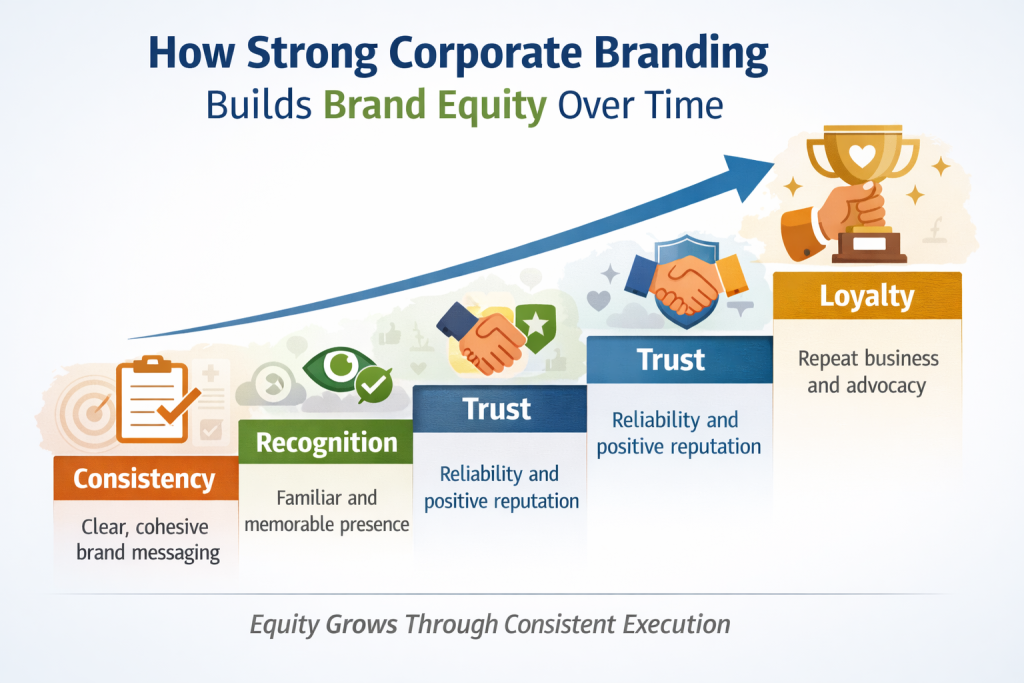
Brand equity is the accumulated value of how people perceive and remember your brand. It is built gradually, through repetition and consistency.
Every positive, on brand interaction adds a small deposit. Over months and years, those deposits compound into something powerful.
Consistency Creates Familiarity
Humans trust what they recognize.
When your website, social channels, presentations, and documents all look and sound like they belong to the same company, recognition forms quickly. People begin to associate your brand with a specific style, tone, and level of quality.
Familiarity does not mean boring. It means coherent.
A coherent brand becomes easy to spot even before the logo appears.
Familiar Brands Lower Buying Friction
Most purchases involve uncertainty. Buyers naturally wonder whether the product will work as promised, whether the company will provide reliable support, and whether the decision will feel worthwhile in the long run.
A strong corporate brand reduces that mental friction.
If a prospect has repeatedly seen your brand show up in a professional, consistent way, their brain labels you as safer. That feeling of safety often matters more than feature comparisons.
Brands that feel established and dependable do not have to fight as hard on price.
Equity Compounds With Every On Brand Touchpoint
Brand equity grows through volume and consistency.
A single polished sales deck does not build equity.
Hundreds of consistently branded decks used across teams do.
The same applies to:
- Marketing emails
- Website pages
- Social posts
- Proposals
- Reports
- Help articles
Each touchpoint reinforces the same mental picture. Over time, that picture becomes hard to dislodge.
That is brand equity.
The Silent Ways Credibility Gets Lost
Credibility is fragile.
Rarely does it collapse in one dramatic moment. More often, it erodes quietly through dozens of small inconsistencies.
Visual Inconsistencies That Signal Carelessness
When prospects notice mismatched logos, strange color choices, or inconsistent fonts, they may not consciously analyze it. But subconsciously, they register something is off.
If a company cannot manage its own presentation, what else might it struggle to manage.
Common visual credibility leaks include:
- Old logo versions in circulation
- Slightly different shades of brand colors
- Random font substitutions
- Low quality imagery mixed with polished visuals
Individually, these seem minor. Collectively, they create a sloppy impression.
Messaging Drift Across Teams
Marketing may describe the company one way. Sales describes it another way. Support explains it differently.
This creates confusion about what the company actually stands for.
Messaging drift happens when teams lack shared frameworks and reference points. Over time, the brand story splinters into multiple versions.
Customers then experience a brand that feels inconsistent and unreliable.
Outdated Assets Still in Circulation
Old decks, old case studies, and outdated templates have a long lifespan.
They get copied. Forwarded. Downloaded. Reused.
Even after a rebrand or messaging update, outdated materials often continue circulating for months or years.
Every time an outdated asset reaches a customer, it undermines the credibility of the current brand.
Corporate Branding vs Marketing vs Product Branding

These three disciplines work together, but they are not interchangeable. Each one serves a distinct purpose, and understanding the difference helps teams avoid confusion, wasted effort, and inconsistent messaging.
Clear separation of roles ensures that strategy, campaigns, and products all move in the same direction.
Corporate Branding
Corporate branding defines who the company is at its core. It includes purpose, values, positioning, identity, and the promise the business makes to customers and employees. Corporate branding is long term and stable, providing the foundation that guides every other brand and communication decision.
Marketing
Marketing focuses on promoting specific offers, campaigns, and initiatives within a given timeframe. Messaging adapts to different channels and audiences, but it should always be anchored in the corporate brand. Strong marketing amplifies corporate branding rather than inventing a separate identity.
Product Branding
Product branding centers on individual products or services, including their names, features, and positioning. It helps differentiate offerings within a portfolio while staying aligned with the broader corporate identity. Product branding should reinforce, not contradict, the company’s core brand promise.
Why Corporate Branding Must Lead
When corporate branding is weak or unclear, marketing and product branding become fragmented and inconsistent. When corporate branding is strong, everything else becomes easier because it acts as the operating system that guides decisions across teams and touchpoints.
Trust Is the Currency of Corporate Brands
Trust is what turns awareness into preference and preference into loyalty.
Corporate branding is one of the primary ways trust is built before a single conversation happens.
Trust Starts Before the First Sales Call
Prospects form opinions long before speaking to anyone.
They evaluate:
- Your website
- Your content
- Your social presence
- Your search listings
If those touchpoints feel cohesive and professional, trust begins to form.
If they feel messy or contradictory, skepticism grows.
Trust Is Reinforced Through Repetition
Trust is not built in one interaction.
It is built when people repeatedly encounter the same quality and tone.
Consistency communicates stability. Stability communicates reliability.
Trust Is Easy to Lose and Hard to Win Back
One off brand proposal. One outdated deck. One confusing email.
Each small slip creates a tiny crack.
Enough cracks, and trust weakens.
That is why corporate branding must be treated as ongoing operational work, not a one time project.
Corporate Branding and Talent Attraction
Corporate branding does not only shape how customers see your company. It also shapes how potential employees evaluate whether they want to be part of it.
People increasingly choose workplaces based on values, culture, and purpose, not just compensation. Your corporate brand is often their first window into what working at your company feels like.
People Want to Work for Brands With Direction
Strong brands communicate a clear sense of direction.
They articulate:
- Why the company exists
- What it is trying to change or improve
- How success is defined
When candidates can easily understand a company’s purpose, they can decide if they align with it. That alignment leads to better hiring outcomes and lower turnover.
Companies with vague or inconsistent branding struggle to communicate who they really are. This makes it harder to attract people who are genuinely invested in the mission.
Internal Branding Shapes Culture
Corporate branding is not just external messaging. It influences internal behavior.
When employees understand the brand values and see them reflected in leadership decisions, policies, and communication, those values become real.
Culture is reinforced through:
- Onboarding materials
- Internal presentations
- Training resources
- Company wide communications
If internal materials feel inconsistent or outdated, employees receive mixed signals about what matters.
Employees Become Brand Messengers
Every employee represents the brand, whether intentionally or not.
They share:
- LinkedIn posts
- Job listings
- Presentations
- Emails
- Conversations with peers
When employees have access to clear brand guidelines and approved assets, they naturally become consistent brand messengers.
When they do not, the brand story fragments.
Market Positioning Comes From Clarity Not Noise
Market positioning is about owning a clear and recognizable place in the minds of your audience. It answers a simple but critical question: what should people immediately associate with your company when they encounter your brand? Corporate branding is the primary mechanism that communicates this answer across every touchpoint, from your website and content to your sales conversations and customer experience.
When corporate branding is consistent and focused, it creates clarity. When branding is scattered or contradictory, it creates noise. Clarity helps brands stand out. Noise makes brands blend in.
Strong Brands Own a Clear Space
Well positioned brands are known for something specific rather than trying to appeal to everyone. They choose a small set of attributes that define who they are, such as reliability, innovation, security, simplicity, premium quality, or accessibility. These attributes are reflected in their visuals, messaging, tone of voice, and behavior.
Because their promise is focused, strong brands feel easier to understand and easier to remember. Every interaction reinforces the same idea, which gradually cements the brand’s position in the market. Over time, this consistency builds recognition and preference.
Weak Brands Try to Be Everything
Brands that lack focus often attempt to speak to too many audiences at once. Their messaging becomes broad and generic in an effort to appeal to as many people as possible. Instead of increasing reach, this approach usually has the opposite effect.
Generic brands struggle to stand out because nothing about them feels distinctive. Messaging changes from campaign to campaign, visuals vary across channels, and the brand feels inconsistent. As a result, noise increases, but recognition does not.
Positioning Makes Growth Easier
Clear positioning simplifies many business decisions. When a brand knows what it stands for, it becomes easier to evaluate marketing ideas, shape product roadmaps, choose partnerships, and expand into new markets.
Teams can ask whether an initiative strengthens or weakens the brand’s core promise. Customers can quickly understand whether the brand is right for them. When people understand what you stand for, they know when to choose you and when not to, which ultimately leads to stronger, more sustainable growth.
Corporate Branding Strategies That Hold Up in the Real World

Strong corporate brands are rarely the result of one standout campaign or a single successful rebrand. They are built through repeatable systems, clear standards, and everyday habits that teams can follow without friction. The most resilient brands focus on foundations first, then design processes that make consistency easy to maintain.
Anchor Brand to Purpose
A corporate brand should be rooted in a genuine company purpose rather than a catchy slogan. Purpose explains why the business exists, the problem it is committed to solving, and the impact it wants to create for customers. When purpose is clearly defined, it becomes a filter for branding decisions.
Purpose influences tone of voice, visual direction, and messaging priorities. It helps teams understand what feels authentic for the brand and what does not. Over time, this alignment ensures that branding feels intentional and credible rather than performative.
Design a Flexible Identity System
A strong identity system balances structure with flexibility. Systems that are too rigid break when real world use cases arise, while systems that are too loose invite inconsistency.
A well designed identity system clearly defines how core elements such as logo usage, color ranges, typography, and layout principles should be applied. At the same time, it allows room for different formats, channels, and creative executions. This balance ensures that the brand remains recognizable across touchpoints without becoming repetitive or restrictive.
Build Internal Brand Education
Employees cannot follow brand rules they do not understand. Internal brand education provides teams with the context they need to apply guidelines correctly and confidently.
Onboarding programs, training sessions, and documentation should explain not only what the rules are, but also why they exist. When people understand the reasoning behind brand standards, they are more likely to respect and follow them in their daily work.
Centralize Brand Assets
One source of truth is essential for consistency. Logos, templates, images, and guidelines should live in a single accessible location that everyone knows and trusts.
When assets are scattered across drives, email threads, and personal folders, teams are forced to guess which version is correct. Centralization removes that guesswork and significantly reduces the risk of outdated or off brand materials being used.
Treat Brand as Ongoing Work
Branding is not a one time project. Markets evolve, products change, and audiences mature. Strong brands review and refine their identity regularly while protecting their core elements.
Ongoing brand work includes periodic audits, updates to guidelines, and adjustments based on business growth. This approach allows the brand to stay relevant without losing the equity it has already built.
Why Most Brand Strategies Fail at the Execution Layer
Many organizations invest heavily in developing brand strategies but underestimate how difficult consistent execution can be without the right infrastructure.
Too Many Storage Locations
Brand assets often live across shared drives, personal folders, email attachments, and chat tools. With no single source of truth, employees spend time searching or relying on old files they happen to have on hand. This leads to inconsistent usage even when people want to do the right thing.
No Clear Ownership
When no team is clearly responsible for brand governance, enforcement becomes informal and inconsistent. Different departments interpret guidelines in their own way, which gradually fragments the brand.
Clear ownership ensures someone is accountable for updating assets, approving changes, and monitoring usage.
Too Much Manual Policing
Relying on people to remember rules and self correct does not scale. Humans naturally default to convenience, especially under deadlines.
If on brand assets are harder to find or use than off brand ones, people will choose the faster option. Execution systems must remove friction rather than add more steps.
What Modern Corporate Branding Infrastructure Looks Like
Strong brands support their strategy with practical systems that make correct execution easy.
Digital Brand Guidelines
Digital brand guidelines provide living documentation that explains visual rules, voice and tone, messaging frameworks, and common use cases. These guidelines should be searchable, easy to navigate, and accessible to everyone who creates content.
Central Asset Library
A central asset library acts as a single hub for approved logos, templates, images, videos, and documents. Version control ensures outdated files do not continue circulating and that teams always use the latest assets.
Workflow Level Brand Controls
Branding should appear inside the tools people already use. When templates, styles, and assets are embedded into everyday workflows, consistency becomes automatic rather than manual.
How Brandy Supports High Stakes Corporate Branding

Brandy provides a centralized brand hub that helps organizations protect consistency at scale without slowing teams down.
With Brandy, companies can create brand portals that house approved assets, templates, and guidelines in one place, giving teams confidence that they are always using the latest versions. Version control prevents outdated files from lingering, while permission settings help manage who can upload, edit, and distribute assets.
Sharing becomes simple, compliance becomes easier, and consistency becomes routine. Instead of relying on memory and manual policing, Brandy helps make on brand work the default behavior.
How to Build a Corporate Branding Strategy That Actually Sticks
Strong branding combines clarity, documentation, and usability. A strategy only works when people can follow it easily.
Define Your Brand Foundations
Clarify your purpose, values, positioning, and audience. Document what the brand stands for and what it does not stand for. These foundations guide every branding decision.
Document Clear Rules
Create practical guidelines for visual identity, voice and tone, and messaging. Keep them simple, specific, and usable so teams can apply them without overthinking.
Make Brand Easy to Use
Provide templates and tools that remove friction from daily work. If using the brand correctly takes more effort than improvising, consistency will always suffer.
Measure and Improve
Audit brand usage periodically, collect feedback from teams, and refine guidelines as the business evolves.
The Long Term Payoff of Protecting Brand Credibility
Corporate branding compounds over time. When managed well, it builds equity, trust, and resilience. When neglected, it slowly drains credibility.
There is no neutral state. Every touchpoint either strengthens or weakens your brand.
Treat corporate branding as high stakes work. Invest in strategy, document the rules, and give teams the tools to execute consistently. That is how brands turn consistency into a long term competitive advantage.