Brand Management Blog & Resources
In 2025, managing product information is no longer a background operational task. It directly affects how fast you launch products, how consistent your brand appears across channels, and how much trust customers place in your business. As companies expand into marketplaces, global ecommerce, partner networks, and digital catalogs, product data becomes harder to control. That is where Product Information Management systems come in.
Modern PIM software helps businesses centralize product data, enrich it with accurate content, align teams around a single source of truth, and publish consistent information everywhere products appear. From ecommerce websites and marketplaces to distributors, catalogs, and sales platforms, PIM plays a critical role in keeping product information clean, complete, and reliable.
This guide compares the best PIM systems in 2025 based on real business needs. Instead of focusing only on features, it looks at usability, scalability, governance, collaboration, and how well each platform fits different stages of growth. Whether you are a startup managing your first catalog or an enterprise handling millions of SKUs, this guide will help you choose the right direction.
What a Modern PIM System Actually Does in 2025
A Product Information Management system acts as the central hub for all product related data. This includes titles, descriptions, specifications, pricing attributes, technical details, translations, and product related assets. In 2025, PIM is no longer just about storing data. It is about making that data usable across teams and channels.
A good PIM system allows product managers, marketers, ecommerce teams, and sales teams to collaborate without stepping on each other’s work. It enforces structure while still allowing flexibility. It ensures every channel receives accurate and up to date information. Also, it helps maintain consistency as catalogs grow larger and more complex.
Without a PIM, product data often lives in spreadsheets, ERP systems, emails, and disconnected tools. This leads to errors, delays, and inconsistent customer experiences. A PIM replaces that chaos with clarity and control.
Key Signs Your Business Needs a PIM Platform
Many businesses delay adopting a PIM until problems become unavoidable. Common signs include frequent product data errors, slow product launches, mismatched descriptions across channels, and constant rework by teams.
If your product catalog is growing quickly, if you sell across multiple channels, or if different teams manage different parts of product data, a PIM becomes essential. It is also critical for businesses expanding internationally, where localization and regional compliance add complexity.
Another clear sign is when marketing and ecommerce teams spend more time fixing product data than improving product performance. A PIM frees teams to focus on growth instead of cleanup.
How We Evaluated the Best PIM Systems for 2025
The platforms in this list were evaluated based on real world usability, scalability, governance, integration capabilities, and suitability for different business sizes. Preference was given to tools that solve actual operational problems rather than offering bloated feature sets.
We also considered how each system fits into a broader digital ecosystem. In 2025, PIM does not exist in isolation. It must work alongside ecommerce platforms, ERP systems, digital asset tools, and brand governance solutions.
Top-rated PIM Systems in 2025
Each of the following platforms serves a different type of business. There is no single best PIM for everyone. The right choice depends on your catalog complexity, team structure, and long term goals.
Brandy

Brandy takes a different but increasingly important approach to product information management. Instead of focusing only on attributes and technical data, Brandy focuses on how product information and brand assets are actually used across teams and channels.
In 2025, product information does not live in isolation. Product visuals, approved descriptions, brand rules, packaging guidelines, and marketing assets are just as critical as specifications. Brandy acts as a centralized brand and product content system that ensures everyone uses the right version of product information every time.
Brandy complements traditional PIM systems by managing approved product visuals, brand guidelines, and usage rules in one place. It is especially valuable for teams working with partners, agencies, distributors, and regional markets where brand misuse is common.
For businesses that already use a PIM but struggle with brand consistency, Brandy fills a crucial gap. It ensures that enriched product data is paired with the right assets and brand context before it reaches customers.
Akeneo

Akeneo remains one of the most widely adopted PIM platforms in 2025. It is known for its strong product enrichment workflows, flexible data modeling, and active open source community. Akeneo helps businesses improve product completeness and consistency across channels with clear attribute management and validation rules.
Marketing teams appreciate its usability, while developers value its extensibility. Akeneo is especially popular among mid market ecommerce brands scaling into omnichannel operations. However, enterprise level governance and advanced features often require higher tier plans, which can increase costs at scale.
Akeneo is best suited for businesses that want flexibility, community support, and strong product enrichment capabilities.
Pimcore

Pimcore is a powerful open source platform that combines PIM, DAM, and data management into a single system. It is designed for organizations with complex data needs that go beyond product information alone.
Pimcore excels in customization and integration. It is ideal for companies with strong technical teams that want full control over data models and workflows. However, it requires development resources and is less plug and play than some SaaS focused PIM tools.
Pimcore works well for enterprises managing complex product structures alongside other types of structured data.
KatanaPIM

KatanaPIM focuses on speed, collaboration, and ease of use. It is particularly popular among B2B wholesalers and mid market brands that need to centralize product data quickly without heavy development work.
The platform offers real time collaboration, clear permissions, and fast onboarding. While it may lack some advanced governance features required by large enterprises, it delivers excellent value for teams that prioritize time to market and simplicity.
KatanaPIM is a strong choice for growing B2B businesses looking for a practical PIM without unnecessary complexity.
Salsify

Salsify positions itself as a product experience platform rather than a traditional PIM. Its strength lies in digital shelf optimization and marketplace syndication. Brands use Salsify to push product data to major retailers while tracking performance metrics such as content quality and conversion impact.
Salsify is powerful but comes with a higher cost and more structured workflows. It is best suited for brands that sell heavily through marketplaces and retail partners and need deep syndication capabilities.
inriver

inriver is built for manufacturers and B2B enterprises managing complex product relationships. Its data model focuses on relationships between products, components, variants, and bundles.
This makes it ideal for industries such as manufacturing, electronics, and industrial equipment. The platform supports large catalogs and distributor networks but typically requires longer implementation cycles.
inriver is best for enterprises that need to manage highly structured product ecosystems at scale.
Contentserv
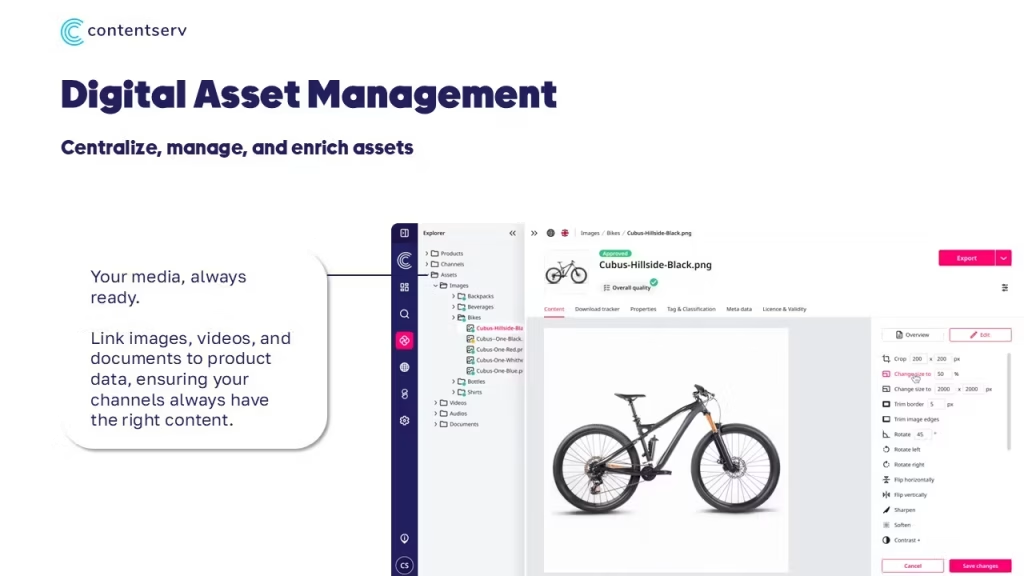
Contentserv offers a comprehensive platform combining PIM, DAM, and marketing workflows with strong governance and localization features. It is designed for global enterprises managing large catalogs across multiple regions and languages.
The platform excels in permission control, audit trails, and localization workflows. However, its extensive feature set means longer onboarding and a steeper learning curve.
Contentserv is ideal for organizations that prioritize governance and regional consistency over speed.
Plytix

Plytix is designed for small teams and startups that want to get started with PIM quickly. It offers an intuitive interface, collaboration tools, and affordable pricing.
While it does not offer enterprise grade automation or deep customization, Plytix covers core PIM needs very well. It is often used by ecommerce startups that need structure without overhead.
Plytix is a great entry point for businesses adopting PIM for the first time.
Catsy
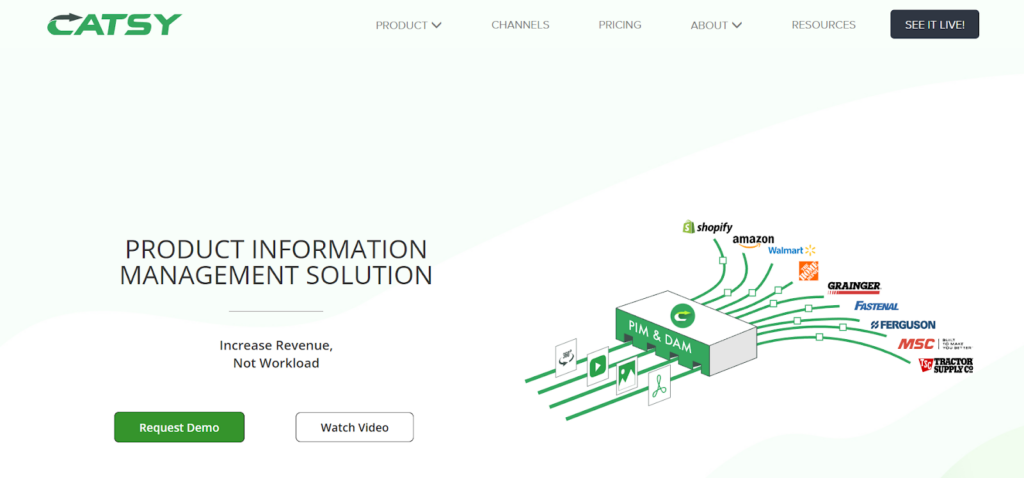
Catsy is a PIM platform tailored for industrial distributors and manufacturers. It includes built in DAM functionality and supports GDSN compliance for supplier networks.
Its strength lies in handling technical attributes, certifications, and structured product data common in industrial sectors. The interface may feel dated compared to newer SaaS tools, but its industry focus makes it valuable for specific use cases.
Catsy is best for industrial enterprises with strict data requirements.
Informatica PIM
Informatica PIM is part of a broader enterprise data management ecosystem. It combines PIM with master data management, data quality, and governance tools.
This makes it suitable for highly regulated industries and very large organizations managing massive datasets. However, it is complex, expensive, and often more than what mid market companies need.
Informatica PIM is best for enterprises that already use Informatica products and require deep governance.
PIM vs DAM vs Brand Systems: What Should You Invest In
PIM manages structured product data. DAM manages digital assets. Brand systems manage rules, consistency, and access. In 2025, successful companies do not choose one. They align all three.
A PIM without brand control leads to inconsistent visuals and messaging. A DAM without structure leads to asset chaos. A brand system without accurate product data creates confusion.
The most effective setups use PIM for structure, DAM for storage, and a brand system like Brandy to govern how product content is actually used.
How to Choose the Right PIM for Your Business Stage
Choosing a PIM is not a one size fits all decision. The right platform depends on where your business is today, how complex your product data is, and how quickly you expect to scale. A system that works perfectly for a startup can feel limiting for an enterprise, while an enterprise grade PIM can overwhelm smaller teams. Understanding your business stage helps you avoid over investing too early or outgrowing your tools too fast.
Early Stage Businesses and Small Teams
For early stage companies, the priority is usually getting organized without slowing down growth. Product information is often scattered across spreadsheets, ecommerce dashboards, and shared folders. At this stage, a PIM should help create structure quickly and reduce manual work, not introduce heavy processes.
Tools like Plytix or Sales Layer are well suited here because they are simple to adopt and easy for non technical users. They allow small teams to centralize product data, clean up inconsistencies, and publish to ecommerce channels with minimal setup. These platforms support collaboration without forcing strict governance that small teams do not yet need. The goal is to build good habits around product data while keeping the team agile and focused on growth.
Growing Ecommerce and B2B Brands
As businesses move into the mid market, product data becomes more complex. Catalogs expand, multiple channels are added, and more people begin working with product information. At this stage, flexibility and collaboration become essential.
Platforms like Akeneo or KatanaPIM are often a good fit because they support richer data models, structured enrichment, and role based workflows. Marketing teams can focus on content quality, product teams can maintain accuracy, and ecommerce teams can manage channel specific requirements without constant duplication. These PIM systems grow with the business, allowing teams to add structure gradually instead of all at once. For B2B brands managing specifications, variants, and customer specific catalogs, this balance of control and usability is especially important.
Manufacturers and Large Enterprises
Manufacturers and enterprises face challenges that go beyond basic product management. Their catalogs are deeply structured, highly relational, and often tied to compliance, regulation, and global distribution networks. At this level, governance and scalability are more important than speed.
Solutions like inriver, Contentserv, or Informatica are built to handle complex hierarchies, multi region data, and strict approval processes. These platforms integrate closely with ERP and master data systems, ensuring consistency across departments and markets. While implementation can be longer and more resource intensive, the payoff is long term stability. For organizations managing thousands or millions of SKUs, a robust PIM becomes a critical operational system rather than just a publishing tool.
Teams Focused on Brand Consistency and Control
Many companies discover that even with a solid PIM, brand inconsistency remains a challenge. Product data may be accurate, but visuals, messaging, and approved assets are still misused across regions, partners, and agencies. This is where pairing a PIM with Brandy makes a real difference.
Brandy adds a layer of brand governance that traditional PIM systems do not cover. It ensures teams always use approved product visuals, descriptions, and brand rules when creating or distributing content. This is especially valuable for organizations working with external partners or operating across multiple markets. By combining a PIM with Brandy, businesses extend control beyond structured data into real world execution, protecting brand integrity while still moving fast.
Final Thoughts
Choosing a PIM system goes far beyond comparing feature lists or pricing tiers. What matters most is how well the platform fits into your daily workflows and supports the people who rely on product information to do their jobs. A PIM should reduce friction, not create it. It should help teams collaborate better, launch products faster, and maintain accuracy as catalogs grow and channels expand.
The right PIM is one that aligns with your current stage while giving you room to evolve. Over time, product data becomes more complex, and the cost of inconsistency increases. That is why scalability and adaptability are just as important as ease of use. When a PIM is paired with strong brand governance, it goes from being a data management tool to a strategic asset. Together, they ensure product information is not only accurate, but also presented in a way that builds trust, reinforces brand identity, and delivers consistent experiences wherever customers interact with your products.