
Content teams today are producing more assets than ever before. Campaigns run across dozens of channels, in multiple formats, and often in several languages. While this explosion of content creates more opportunities to connect with audiences, it also increases the risk of publishing something inaccurate, off brand, or non compliant.
Most organizations still rely heavily on manual review processes to protect their brand. Spreadsheets, email approvals, and last minute checks slow teams down and still leave room for error. As content volume grows, these approaches become harder to sustain and easier to bypass.
This is where AI powered digital asset management changes the equation. By embedding intelligent content moderation directly into DAM workflows, brands can enforce governance automatically, reduce risk, and move faster without sacrificing control. Smarter content governance starts with building guardrails into the system itself.
What Content Governance Really Means in Today Organizations?
Many teams misunderstand content governance as a final approval step before publishing. In reality, it defines a framework that shapes how teams create, review, store, share, and retire content across the organization.
Strong content governance answers essential questions such as:
- Who is allowed to create which types of content
- Which rules define what is acceptable or unacceptable
- How brand standards are enforced
- Where approved content lives
- How long content can be used
- What happens when content becomes outdated
When governance is weak or fragmented, teams create their own processes. Marketing may use one system. Regional teams use another. Agencies operate with separate guidelines. Over time, these differences turn into visible inconsistencies.
Effective governance connects policy with execution. It ensures that brand rules are not just written down but actively applied inside daily workflows.
Governance vs Compliance vs Moderation
Although these terms are related, they serve different purposes.
Content governance is the overarching system. It defines ownership, standards, and processes.
Compliance focuses on legal and regulatory obligations. This includes privacy laws, advertising regulations, licensing terms, accessibility standards, and industry specific rules.
Content moderation is the operational enforcement layer. It is the mechanism that reviews content and determines whether it meets governance and compliance requirements.
Together, they form a continuous loop:
- Governance defines the rules
- Compliance identifies mandatory constraints
- Moderation enforces both
Without moderation, governance exists only on paper. Without governance, moderation becomes inconsistent.
Why Governance Breaks at Scale
Most organizations do not intentionally design poor governance. It usually breaks as a side effect of growth.
Common causes include:
- Rapid expansion into new markets
- Increased number of contributors
- More channels and platforms
- Heavy reliance on agencies and freelancers
- Growing use of AI generated content
As volume increases, manual processes become harder to sustain. Reviewers get overwhelmed. Shortcuts happen. Old assets get reused because they are easy to find. New hires do not fully understand brand rules.
This is where AI powered DAM becomes essential. It introduces consistent enforcement regardless of who uploads content, where they are located, or how fast they are working.
Why Manual Content Moderation No Longer Works?
Manual moderation depends on people noticing problems. This sounds reasonable until you examine the scale of modern content operations.
A single campaign can generate hundreds of assets. Multiply that by regions, languages, channels, and ongoing optimization cycles. Even large review teams cannot realistically inspect every file with the same level of attention.
Volume and Speed Challenges
Content teams are under constant pressure to ship faster.
Deadlines are shorter. Campaign cycles are tighter. Real time marketing is expected.
When moderation relies entirely on humans:
- Reviews get rushed
- Checks become superficial
- Edge cases are missed
- Fatigue leads to errors
Speed and accuracy start to compete with each other. Something always gives.
Inconsistent Decisions Across Teams
Another problem with manual moderation is subjectivity.
Two reviewers may interpret brand guidelines differently. One may be strict. Another may be lenient. Regional teams may adapt standards in ways that drift over time.
This creates a patchwork of enforcement where:
- Some assets are blocked
- Others pass with similar issues
- Teams become frustrated
- Trust in the process declines
AI introduces consistency. The same rules are applied in the same way every time.
What Is AI Content Moderation Inside a DAM Platform?
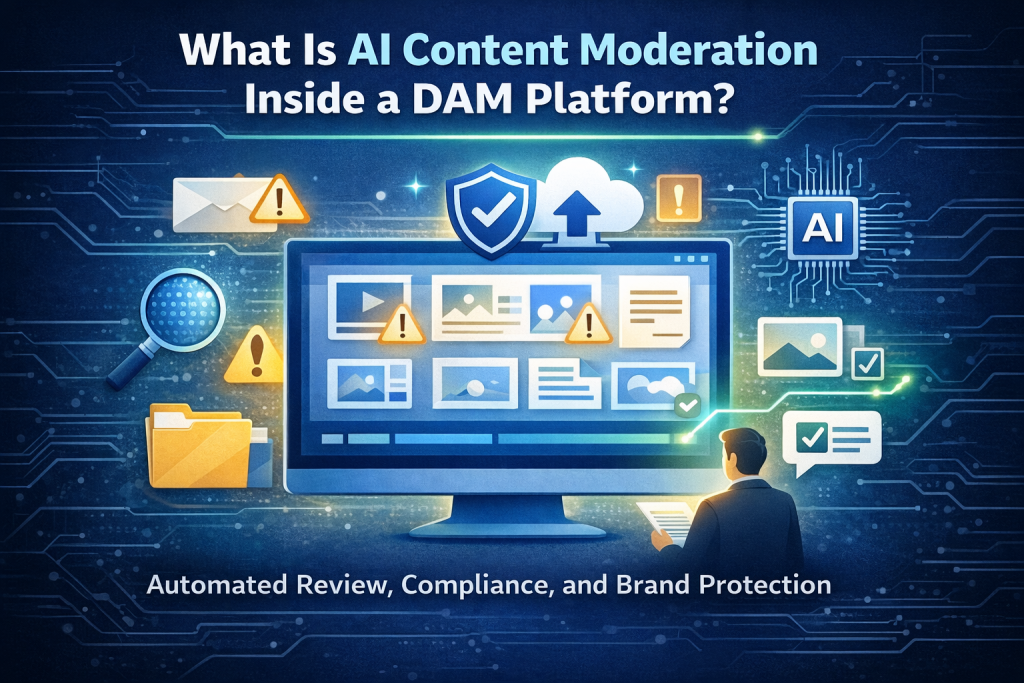
AI content moderation refers to using artificial intelligence to automatically analyze digital assets and flag potential issues related to safety, compliance, and brand alignment.
Inside a DAM platform, moderation is not a standalone tool. It is embedded into asset workflows.
When content is uploaded, edited, or prepared for distribution, AI evaluates it against defined criteria.
These criteria may include:
- Restricted words or phrases
- Sensitive imagery categories
- Brand tone guidelines
- Logo placement and usage
- Color and typography standards
- Licensing and usage rights
- File format and quality requirements
Instead of waiting for a human to discover problems, AI surfaces them immediately.
Core Technologies Powering AI Moderation
Several AI disciplines work together inside moderation systems.
Natural language processing analyzes text for meaning, tone, and context.
Computer vision examines images and video frames to identify objects, logos, faces, and visual patterns.
Machine learning models learn from historical moderation decisions and improve over time.
Pattern recognition detects similarities, duplicates, and anomalies across large libraries.
Together, these technologies allow DAM platforms to evaluate content at a scale humans cannot match.
Where Moderation Fits in the DAM Lifecycle
AI moderation is not limited to a single moment.
It can operate at multiple stages:
- When assets are uploaded
- When assets move into review
- When assets are approved
- When assets are distributed
- When assets are reused
This continuous monitoring ensures governance is maintained throughout the entire asset lifecycle.
How AI Powered DAM Enforces Governance Automatically?
AI moderation becomes truly powerful when it is tied directly to governance policies.
Instead of generic filters, organizations define their own rules inside the DAM. AI then enforces those rules consistently.
Automated Policy Checks at Upload
The moment a file enters the DAM, AI can run checks such as:
- Does the text contain restricted terminology
- Is the image flagged for sensitive content
- Is required metadata present
- Is the resolution high enough
- Is the file type allowed
If issues are detected, the system can:
- Block the upload
- Flag the asset
- Route it to review
- Request corrections
This prevents risky content from entering circulation.
Brand Guideline Validation
AI can compare assets against brand standards.
For example:
- Logos are verified against approved versions
- Color palettes are checked for accuracy
- Typography is validated
- Layout structures are compared to templates
This ensures that even fast moving teams stay visually and verbally consistent.
Usage Rights and Expiration Monitoring
Many organizations manage thousands of licensed images, videos, and audio clips.
AI can track:
- License start and end dates
- Geographic restrictions
- Channel limitations
When an asset approaches expiration, the DAM can alert users or automatically restrict usage. This protects brands from accidental rights violations.
The Role of AI in Monitoring Content Beyond the DAM
Governance does not stop at the asset library. Once content is published, it lives across websites, ads, social platforms, partner portals, and marketplaces.
AI can help extend governance into these external environments.
Detecting Assets Used on Live Websites and Campaigns
AI can scan the web to locate where specific assets appear.
This gives teams visibility into:
- Which sites are using which assets
- Whether usage aligns with permissions
- Whether outdated versions are still live
Identifying Outdated or Unauthorized Usage
When brand updates occur, old assets often remain in circulation.
AI can detect:
- Legacy logos
- Old product imagery
- Expired campaign visuals
- Unapproved variations
This allows teams to take action before inconsistencies spread further.
Why Human Oversight Still Matters in AI Moderation?
AI is powerful, but it is not infallible. Content often requires context, nuance, and cultural understanding.
Where AI Excels
AI is exceptional at:
- High volume scanning
- Pattern detection
- Consistent rule enforcement
- Real time flagging
These strengths remove massive operational burden.
Where Humans Are Essential
Humans remain critical for:
- Interpreting complex context
- Making ethical judgments
- Evaluating creative intent
- Resolving ambiguous cases
The strongest moderation systems combine both.
AI handles the heavy lifting. Humans make the final calls.
Different Types of AI Moderation Models

AI content moderation is not limited to a single operational framework. Organizations can adopt different moderation models depending on their industry, regulatory exposure, publishing speed, and internal governance maturity. Modern DAM platforms typically allow brands to combine multiple models to create a layered governance approach that balances efficiency and oversight.
Understanding these models helps organizations design moderation systems that align with both risk tolerance and business agility.
Pre Moderation
Pre moderation reviews content before anyone can see, distribute, or approve it for use. AI analyzes the asset immediately after upload and determines whether it complies with defined governance standards. When AI detects violations, the system either blocks the asset or routes it to a designated reviewer.
This model is particularly valuable in industries where regulatory compliance is strict and reputational risk is high. Examples include healthcare communications, financial product promotions, pharmaceutical marketing materials, and legal documentation.
Pre moderation reduces exposure by ensuring that risky content never reaches customers, partners, or public channels. It creates a protective barrier at the entry point of the content lifecycle, preventing governance issues from spreading further into workflows.
Post Moderation
Post moderation allows content to move forward in the workflow while AI continues analyzing it in the background. If an issue is identified after publication or approval, the asset can be flagged, restricted, or removed.
This approach is often used in environments that prioritize speed and responsiveness, such as social media campaigns, event driven content, or real time marketing initiatives. Teams are able to publish quickly without waiting for extended review cycles, while governance mechanisms still remain active.
Post moderation does not eliminate risk entirely, but it significantly reduces long term exposure by detecting and correcting issues shortly after release. It offers a practical balance between agility and control.
Reactive Moderation
Reactive moderation is triggered by human intervention rather than automated detection alone. Users can report content that appears inappropriate, inaccurate, or misaligned with brand standards. Once reported, AI can prioritize the content for review and analyze it for violations.
This model empowers employees, regional teams, and stakeholders to participate in governance. It creates shared accountability while maintaining structured oversight.
Reactive moderation works especially well in large organizations where thousands of assets are used daily and not every risk can be anticipated by predefined rules.
Distributed Moderation
Distributed moderation relies on collective input from multiple users. Contributors may vote, comment, or tag content based on quality, relevance, or appropriateness. AI aggregates these signals to detect patterns and highlight assets that require attention.
This model is common in collaborative environments or decentralized content ecosystems where many stakeholders contribute materials.
While distributed moderation can enhance transparency and participation, it still benefits from AI reinforcement to ensure decisions remain aligned with formal governance policies.
Hybrid Moderation
Hybrid moderation combines automated AI analysis with structured human oversight. AI handles repetitive screening tasks such as scanning for restricted terms, detecting expired licenses, or validating logo usage. More complex or ambiguous cases are escalated to human reviewers.
This model is widely considered the most effective governance strategy because it delivers both scalability and nuance. AI ensures consistency and speed, while humans apply contextual understanding and ethical judgment.
Hybrid moderation allows organizations to expand content operations without sacrificing accountability or brand integrity.
Business Benefits of AI Moderation in DAM
When AI moderation is embedded into digital asset management systems, governance transforms from a reactive control function into a proactive business enabler. The impact extends beyond risk reduction and influences operational efficiency, creative productivity, and brand trust.
Faster Time to Market
Manual moderation often introduces bottlenecks in content workflows. Review queues grow longer, feedback cycles become repetitive, and publishing timelines stretch unnecessarily. AI moderation reduces these delays by automatically scanning assets and flagging only those that require attention.
Instead of reviewing every asset manually, teams can focus their efforts on edge cases and high risk scenarios. This accelerates campaign launches and enables organizations to respond more quickly to market opportunities.
Faster time to market does not mean compromising governance. It means embedding governance directly into the system so that compliance checks occur simultaneously with content creation.
Lower Brand and Legal Risk
Brand risk often arises from small oversights that compound over time. An outdated product disclaimer, an expired stock image license, or a slightly altered logo may seem minor in isolation, but at scale these inconsistencies damage credibility.
AI moderation reduces this exposure by continuously scanning assets against defined standards. It helps detect:
- Expired licensing terms
- Incorrect logo usage
- Sensitive or restricted terminology
- Non compliant visual elements
- Region specific violations
By identifying these issues early, organizations protect both reputation and revenue. Risk management becomes systematic rather than dependent on individual vigilance.
Scalable Governance Without Expanding Review Teams
As content volume increases, manual governance requires proportional growth in moderation resources. This creates higher operational costs and still does not guarantee consistency.
AI moderation absorbs the majority of repetitive checks and allows organizations to scale output without scaling headcount at the same rate. Review teams transition from gatekeepers to strategic advisors who oversee high impact decisions rather than inspecting every asset individually.
This shift improves morale, reduces burnout, and enhances the overall efficiency of governance operations.
Common Risks of AI Generated Content Without Governance
The rise of generative AI has significantly increased content production capacity. However, without proper moderation systems, this productivity introduces substantial risk.
AI generated content can produce plausible sounding information that is factually incorrect. These hallucinations may not be obvious at first glance, particularly when technical language is involved. Publishing inaccurate information can undermine customer trust and expose brands to liability.
Bias is another concern. AI models are trained on large datasets that may reflect societal or cultural biases. Without governance controls, biased or insensitive messaging can slip into published materials, potentially harming brand perception.
There is also the risk of brand dilution. Generative AI may produce content that technically satisfies a prompt but fails to align with brand voice, tone, or positioning. Over time, inconsistent messaging weakens brand identity and confuses audiences.
Embedding AI moderation within DAM ensures that generative output is evaluated against structured governance criteria before distribution. This maintains both creativity and accountability.
What to Look for in an AI Powered DAM for Content Governance?
Selecting a DAM platform with AI moderation capabilities requires careful evaluation. Not all solutions offer the same level of transparency, configurability, or integration depth.
Organizations should prioritize platforms that allow customizable governance frameworks rather than rigid, generic filters. The system should support:
- Custom rule definitions
- Industry specific compliance settings
- Regional policy variations
- Flexible escalation workflows
Transparency is equally important. Teams must understand why content was flagged and how decisions were made. Detailed audit logs and traceable moderation histories build trust in the system and support regulatory reporting requirements.
Human in the loop workflows are essential. AI should assist decision making, not replace it entirely. The platform must make it easy for authorized users to review flagged content, provide context, and override automated decisions when appropriate.
A well designed AI powered DAM strengthens governance while preserving human authority.
How Brandy Supports AI Driven Content Governance?

Brandy enables organizations to centralize brand standards and integrate governance directly into content workflows. Instead of relying on separate documents or disconnected approval systems, teams can embed brand rules into the asset management environment itself.
Centralized brand standards ensure that approved logos, color systems, messaging guidelines, and usage policies are stored in one authoritative location. Contributors work within this structured framework rather than interpreting brand requirements independently.
AI assisted workflows help identify potential inconsistencies early. The system automatically flags assets that deviate from defined standards, allowing reviewers to focus on refinement rather than discovery.
Controlled access and distribution permissions further strengthen governance. Teams define who can download, edit, and publish specific assets, which reduces unauthorized usage and ensures only approved materials are shared externally.
By combining structured governance with AI assistance, Brandy supports scalable brand integrity across growing content ecosystems.
Getting Started With AI Moderation in Your Organization
Implementing AI moderation does not require a complete system overhaul on day one. Organizations can begin with targeted initiatives and expand gradually as governance maturity increases.
The first step is defining clear governance policies. AI cannot enforce ambiguous rules. Teams must clearly document brand standards, compliance requirements, and asset ownership structures and align them across the organization.
Next, organizations should identify high risk content categories. These may include advertising creatives, regulated product information, licensed imagery, or global campaigns. Starting with high impact areas delivers immediate value while minimizing disruption.
Finally, moderation systems should evolve through continuous refinement. Reviewing flagged cases, analyzing false positives, and updating rule configurations ensures that AI remains aligned with business objectives.
AI moderation is not a static implementation. It is an adaptive governance layer that improves over time.
Future Proofing Your Brand With Smarter Governance
Content ecosystems will continue to expand across platforms, regions, and formats. Relying solely on manual review is no longer sustainable in this environment.
AI powered DAM provides a structured, scalable approach to governance that supports both speed and safety. By embedding moderation into the asset lifecycle and combining automation with human oversight, organizations create resilient brand infrastructure.
Smarter governance is not simply about preventing mistakes. It is about enabling confident growth in a world where content defines reputation.