
Automation and AI have become permanent fixtures inside modern marketing teams. Campaigns that once took weeks to plan and execute can now be launched in days. Content that once required multiple handoffs can be generated with a single prompt. Personalization that once felt impossible at scale is now expected.
This speed creates opportunity. It also creates risk.
As more content, messages, and documents are produced automatically, brands face a new reality. Every automated output represents your company in front of customers, prospects, and partners. When those outputs are inconsistent, inaccurate, or non compliant, the damage compounds quickly.
The real challenge is no longer whether to automate. That question has already been answered. The challenge is how to automate in a way that protects brand integrity, maintains quality, and supports growth instead of undermining it.
This guide explains what marketing automation truly means in 2026, where brand risk enters the picture, and how to build an automation strategy that delivers speed without sacrificing control.
What Marketing Automation Really Means in 2026
Marketing automation used to be synonymous with email campaigns and lead scoring. That definition is now outdated.
Today, marketing automation refers to an interconnected ecosystem of platforms that coordinate data, workflows, content, and decision making across the entire customer lifecycle. It touches everything from awareness campaigns to sales proposals to customer renewal communications.
Automation now operates at three levels:
- First, it orchestrates journeys. Platforms manage how prospects move from one interaction to the next, triggering messages based on behavior, intent, and timing.
- Second, it generates content. Documents, presentations, landing pages, emails, and ads can all be assembled automatically using templates, rules, and data.
- Third, it optimizes performance. Analytics and decisioning engines continuously evaluate results and adjust campaigns to improve outcomes.
When these layers work together, marketing becomes faster, more predictable, and more scalable.
When they do not, teams end up with fragmented systems that move quickly but create chaos behind the scenes.
Marketing Automation beyond Email Campaigns
Email remains an important channel, but it represents only a small portion of modern automation.
Marketing teams now automate:
- Lead nurturing and qualification
- Account based marketing journeys
- Sales follow ups
- Proposal and contract generation
- Customer onboarding sequences
- Renewal and expansion communications
- Event and webinar workflows
- Paid media audience syncing
Each of these workflows produces customer facing content. Each one must reflect the same brand voice, positioning, and standards.
Automation is no longer just a growth tool. It is a brand delivery mechanism.
Why Automation Is Now Part of Core Revenue Infrastructure?
Automation platforms sit at the center of revenue operations.
- They influence how quickly leads are followed up.
- They shape how sales teams present value.
- They determine how consistent messaging appears across touchpoints.
When automation works well, it shortens sales cycles, increases conversion rates, and improves deal quality. When automation fails, it introduces friction that quietly kills revenue. Prospects receive conflicting information. Sales sends outdated pricing. Proposals look different depending on who created them.
In 2026, automation is not a supporting system. It is part of the foundation of how revenue is generated.
The Hidden Cost of Scaling Automation Without Governance
Automation promises efficiency. Without governance, it delivers inconsistency at scale.
Many organizations discover this problem only after automation has already spread across teams and regions.
How Brand Inconsistency Quietly Erodes Trust?
Brand inconsistency rarely appears as a dramatic failure.
It shows up in small ways.
- A proposal uses an outdated logo.
- A slide deck uses the wrong font.
- An email sounds nothing like the website.
- A case study includes old messaging.
Individually, these issues seem minor. Collectively, they create doubt.
Prospects notice when a company does not present itself consistently. It signals disorganization, raises questions about attention to detail, and weakens perceived credibility.
Trust is built through repetition. Consistency is what makes repetition believable. Automation that multiplies inconsistency damages trust faster than manual processes ever could.
How Compliance Risks Multiply at Scale?
Compliance problems follow the same pattern.
- One missing disclaimer becomes thousands of missing disclaimers.
- One outdated claim becomes a global issue.
- One incorrect regional variation becomes a regulatory risk.
Manual review cannot keep up with high volume automated output. Even large compliance teams struggle when content is generated continuously.
Without built in controls, automation becomes a liability instead of an advantage.
Why Speed Alone Does Not Equal Efficiency?
Speed feels productive.
- But speed without accuracy creates rework.
- Speed without standards creates confusion.
- Speed without control creates risk.
True efficiency means producing correct, approved, on brand content the first time.
A slower process that produces reliable output often costs less than a fast process that generates constant fixes. The goal of marketing automation is not maximum output. The goal is dependable output at scale.
What a High Maturity Marketing Automation Strategy Looks Like
High performing organizations treat automation as an operating model, not a collection of tools. They design systems that balance autonomy with control.
Centralized Control with Decentralized Execution
Teams should be able to move quickly without reinventing brand standards every time they create content.
This requires central ownership of:
- Templates
- Brand guidelines
- Approved messaging
- Legal clauses
- Product descriptions
At the same time, local teams need flexibility to personalize and adapt within defined boundaries.
High maturity strategies create this balance by embedding rules inside systems rather than relying on people to remember them.
Automation Designed Around Business Outcomes
Automation should exist to solve specific problems.
- Increase conversion rates.
- Reduce sales cycle length.
- Improve renewal rates.
- Lower content production costs.
High maturity organizations map workflows to outcomes. They do not automate simply because a feature exists.
Every automated sequence has a purpose tied to revenue, retention, or efficiency.
Governance Built Into the System, Not Added Later
Governance cannot be an afterthought. If controls are layered on after automation is live, teams will find ways around them. When governance is built directly into templates, workflows, and data connections, compliance becomes automatic.
The best strategies make the right thing the easy thing.
The Six Core Categories of Marketing Automation Platforms
Marketing automation is not a single platform category. Enterprises rely on multiple types of tools that solve different problems across the marketing and revenue lifecycle.
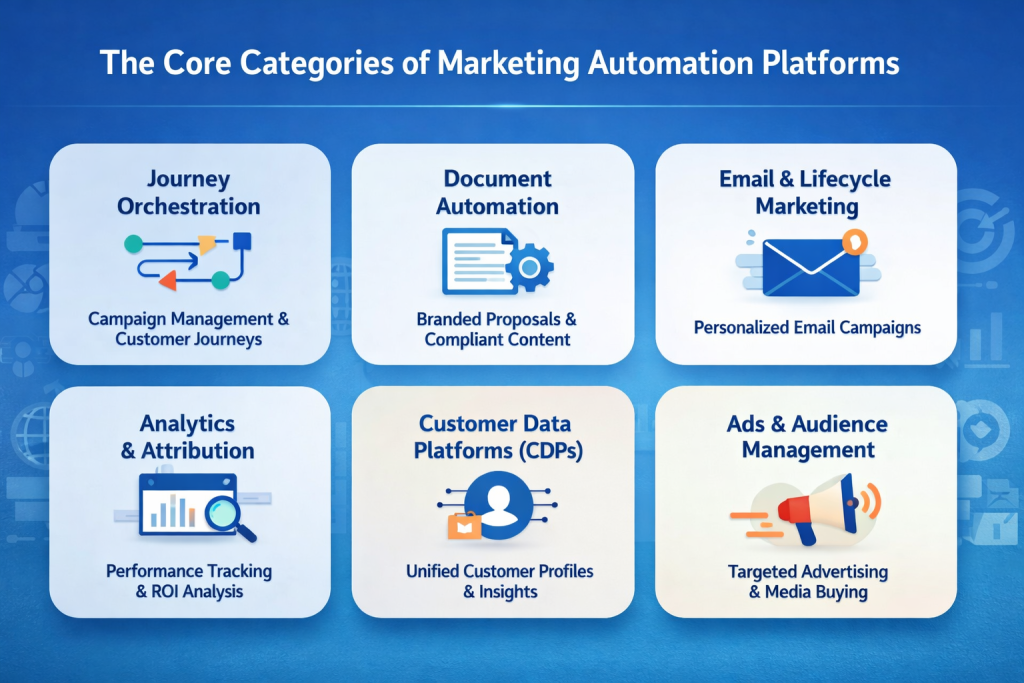
Understanding these categories helps clarify where governance must exist.
Journey Orchestration and Campaign Automation Platforms
These platforms manage multi channel campaigns and customer journeys. They trigger actions based on behavior, segment audiences, score leads, and coordinate messaging across email, web, social, and ads. Their strength is timing and orchestration.
Their weakness is content governance. Most assume content already exists and is approved.
Document Generation and Brand Automation Platforms
These platforms focus on high value customer facing documents such as proposals, contracts, presentations, and reports. They assemble content using templates, rules, and live data from connected systems. They apply brand standards automatically and ensure approved language is used.
This category is critical for protecting brand integrity inside revenue teams.
Email and Lifecycle Marketing Platforms
Dedicated email platforms handle large volumes, advanced segmentation, and behavioral triggers. They optimize subject lines, send times, and personalization. They still rely on underlying content and templates, which means governance remains essential.
Analytics and Attribution Platforms
These tools track performance across channels and connect marketing activity to revenue. They answer questions about what works and what does not. While they do not generate content, they inform where automation investments should be made.
Customer Data Platforms and Personalization Engines
CDPs unify customer data into a single profile. Decisioning engines use that data to trigger personalized experiences in real time. They form the data foundation of automation. If data governance is weak, personalization becomes risky.
Ads and Audience Management Platforms
Advertising platforms automate bidding, budgeting, and audience targeting. They increasingly function as automation engines.
Creative and messaging consistency still matters, even in paid channels.
Where Brand Risk Enters the Automation Stack
Brand risk does not come from one tool. It emerges from the connections between tools.
Templates without Control Become Liabilities
When teams download templates, edit them locally, and upload new versions, chaos follows.
- Multiple versions circulate.
- Old branding persists.
- No one knows which template is correct.
Automation that relies on uncontrolled templates spreads these problems faster. Centralized, locked templates are the only scalable solution.
AI Outputs without Guardrails
AI can accelerate content creation dramatically. It can also generate incorrect claims, inconsistent tone, and off brand language.
Without defined rules, AI becomes a brand roulette machine. Governed AI means models operate inside approved frameworks, not as freeform generators.
Data Integrations without Validation
Automation platforms pull data from many systems.
- If pricing tables are outdated.
- If product names change.
- If regional rules differ.
Errors flow directly into customer facing content. Validation rules and synchronized sources of truth are essential.
How to Build a Marketing Automation Strategy That Protects Your Brand
A successful strategy starts with structure. It does not begin with tool selection.
Step 1: Map Your Customer Journeys and Content Touchpoints
Document how prospects and customers move through your lifecycle. List every touchpoint where content is created or delivered. Identify which steps involve manual work, delays, or frequent errors.
These areas represent the highest automation opportunity.
Step 2: Prioritize Workflows Tied to Revenue
Focus first on workflows that influence pipeline and deals.
Examples include:
- Lead follow ups
- Sales proposals
- Renewal communications
- Onboarding materials
These workflows deliver measurable ROI and justify investment.
Step 3: Define Brand and Compliance Rules in Advance
Before automating anything, document:
- Brand voice and tone
- Visual identity standards
- Approved claims
- Required disclaimers
- Regional variations
These rules become the foundation of governed automation.
Step 4: Select Platforms Based on Control Capabilities
Once brand and compliance rules are clearly defined, platform selection becomes much more strategic. The goal is not to choose the tool with the longest feature list. The goal is to choose platforms that actively enforce your standards instead of relying on people to remember them.
Many automation tools help teams move faster, but fewer help teams stay consistent. That difference matters at scale. A strong platform should prevent unauthorized template edits, automatically apply brand styles, and restrict which content elements users can add to documents or campaigns.
When evaluating vendors, look for platforms that support locked templates, centralized template libraries, built in brand styling, and permission based editing. It is also important to understand how the platform validates data before content is generated and whether it records who created or modified content.
Most successful enterprises do not rely on a single all in one system. They use a combination of specialized tools that integrate well with each other. What matters most is that these platforms share data reliably and operate on the same source of truth.
Step 5: Design Workflows with Quality and Scalability in Mind
Automation workflows should be designed as production systems rather than simple sequences of actions. As volume increases, even small weaknesses in a workflow can quickly become major operational problems.
Every workflow should include built in safeguards that maintain quality regardless of who initiates it. This often includes automated template selection based on use case, pre filled approved content blocks, and validation rules that require key fields to be completed before output is generated.
Approval routing is also important for high risk or regulated content. Sensitive materials should automatically be sent to the appropriate stakeholders before they are finalized. In addition, workflows should include fallback logic for situations where data is missing or incomplete, so content is not generated using incorrect assumptions.
Before rolling out any workflow broadly, teams should test it using realistic scenarios. This includes edge cases, incomplete records, and unusual combinations of data. Catching problems early prevents brand and compliance issues later.
Step 6 Connect Automation to Your Full Stack
Marketing automation delivers the most value when it is connected to the rest of your technology ecosystem. When platforms operate in isolation, teams are forced to manually copy information between systems, which increases errors and slows execution.
High performing organizations connect automation platforms with their CRM for customer and opportunity data, DAM systems for approved brand assets, CMS platforms for web content, ERP or pricing systems for financial data, and sales enablement tools for collateral.
These integrations create a single source of truth across marketing and revenue teams. When product messaging changes, pricing updates, or brand assets are refreshed, those changes flow automatically into automated workflows. This ensures that every piece of content reflects the most current information without requiring manual intervention.
Step 7 Establish Measurement and Continuous Optimization
Automation should never be treated as a one time implementation. Ongoing measurement and optimization are essential to ensure workflows continue to deliver value.
Metrics should be defined at two levels. Performance metrics measure business impact, such as conversion rates, pipeline influenced, revenue generated, and time saved. Quality metrics measure how well brand and compliance standards are being maintained.
Quality focused indicators might include template usage rates, compliance adherence, error frequency, and rework volume. Tracking both performance and quality prevents teams from optimizing for speed alone.
Regular reviews of these metrics allow teams to identify bottlenecks, improve workflows, and refine governance rules as the business evolves.
The Role of Document Automation in Revenue Teams
Despite the rise of new digital channels, documents remain central to most buying decisions. Proposals, presentations, statements of work, and contracts often contain the most detailed explanation of value and pricing that a prospect receives.
These assets shape how prospects perceive your organization. They communicate whether your company is professional, organized, and reliable. When documents look inconsistent or contain errors, prospects begin to question whether internal operations are equally disorganized.
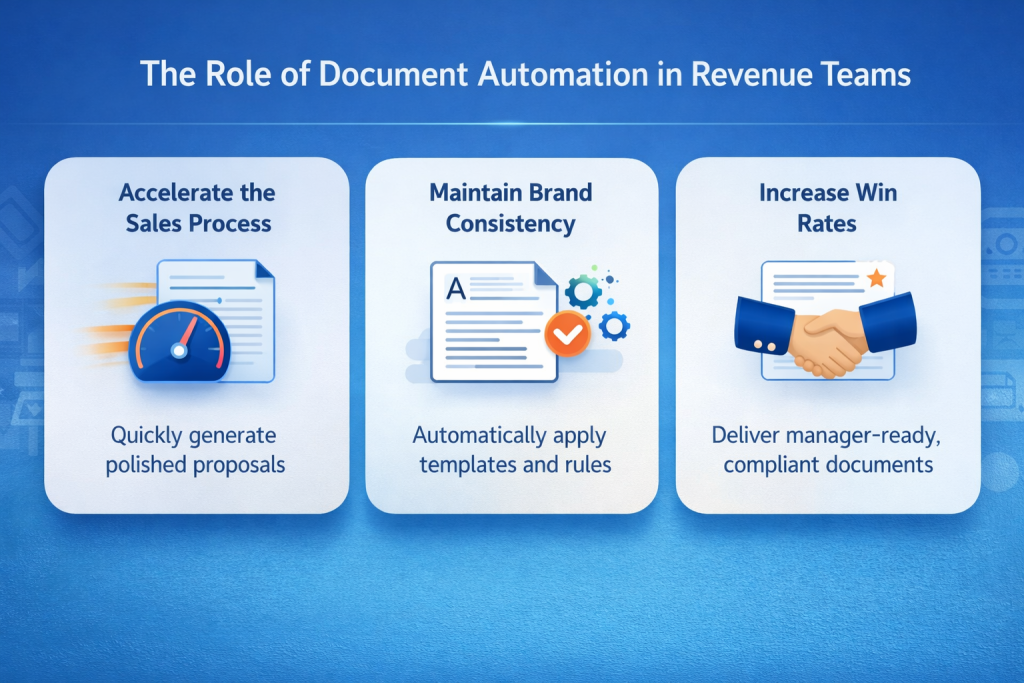
Document automation ensures that these critical assets are generated quickly and consistently. Instead of starting from scratch or reusing outdated files, teams create documents from approved templates that automatically apply brand standards and pull in current data.
This approach reduces turnaround time while maintaining accuracy. Sales teams spend less time formatting and more time engaging with prospects. Marketing teams maintain confidence that brand standards are being followed. Leadership gains visibility into how documents are used across the organization.
Why Documents Still Play a Decisive Role in Closing Deals?
A proposal is often the final checkpoint before a buying decision. It summarizes the solution, the value, and the commercial terms. Any inconsistency at this stage creates doubt.
When proposals are polished, consistent, and aligned with brand standards, prospects experience a sense of professionalism that builds confidence. That confidence shortens decision cycles and increases the likelihood of approval.
How Automated Document Generation Accelerates Deals?
Automated document generation removes many of the friction points that slow sales teams down. Reps no longer search through folders for templates or manually copy content from previous documents.
Instead, they answer a few guided questions and a complete document is assembled automatically using approved templates and live data. This allows sales teams to respond faster without sacrificing quality.
Faster turnaround combined with consistent presentation creates a better buying experience and improves close rates.
Why Brand Safe Documents Increase Win Rates?
Brand safe documents ensure that every proposal, presentation, and contract looks and sounds like it came from the same organization, regardless of who created it.
This consistency reinforces trust. Trust reduces perceived risk. Reduced risk makes it easier for buyers to say yes.
Over time, this effect compounds across thousands of interactions, contributing directly to revenue growth.
What to Look for in a Brand Safe Automation Platform
Not all automation platforms are designed with brand governance in mind. Evaluating vendors through a brand safety lens helps prevent future problems.
A strong platform should offer centralized template management so updates can be made once and applied everywhere. It should connect directly to CRM, DAM, and business systems so content pulls from approved data sources.
AI capabilities should operate inside defined guardrails, using approved language and restricted data sources. Role based permissions should control who can create, edit, and publish content. Audit trails should provide visibility into content creation and modification.
These capabilities ensure that automation supports growth without introducing unnecessary risk.
How Brandy Supports Brand Governed Marketing Automation
Brandy provides a centralized environment for managing approved brand assets, templates, and guidelines. It becomes the single source of truth that marketing and revenue teams rely on when creating content.

When connected to automation platforms, Brandy ensures that only approved assets and templates are used inside automated workflows. This prevents off brand content from entering campaigns, documents, and customer communications.
For growing organizations, this approach allows teams to scale output without sacrificing consistency. Teams move faster because they do not waste time searching for assets. Leaders maintain confidence because brand standards are enforced automatically.
Common Mistakes Teams Make With Marketing Automation
One common mistake is buying tools before defining workflows. Without clear use cases, automation becomes fragmented and difficult to measure.
Another mistake is treating governance as something that can be added later. Retroactive governance is expensive and disruptive. Controls should be built in from the beginning.
Teams also sometimes over automate without considering where human judgment is still required. High value or high risk touchpoints benefit from human oversight.
Finally, many organizations measure only speed. Focusing exclusively on volume ignores the importance of quality and business impact.
A Practical Starting Point for Most Organizations
Most organizations succeed by taking a phased approach. They begin with a small set of high impact workflows tied to revenue. Next, they establish centralized templates and governance. Then they introduce AI and personalization. Finally, they optimize and expand.
This approach balances momentum with control.
Final Thoughts: Scale Faster Without Betting Your Brand
Marketing automation is essential for growth. Brand governance is essential for sustainability.
When these two capabilities are designed together, automation becomes a competitive advantage rather than a risk.
Organizations that embed brand control into their automation strategy will scale faster, close more deals, and protect the trust they have worked hard to build.