
Living brand guidelines represent the most effective approach for modern organizations. Most brand teams still manage their brands with PDFs, but living brand guidelines are transforming how companies maintain brand consistency.
Living brand guidelines vs static style sheets remains a critical gap in how organizations manage brand assets. It gets created once, shared once, and then quietly ignored. New hires never see it. Designers interpret it differently. Developers hardcode values that should be variables. And every time the brand evolves, someone has to manually update a document that no one actually reads.
There is a better way to manage brand standards in 2026. It starts with understanding the difference between a static stylesheet and a living brand system, and where design tokens fit into that shift.
Living Brand Guidelines: What is a Living Brand Style Guide?
Living brand guidelines, specifically a living brand style guide, represent a dynamic, cloud-based brand reference that updates in real time and stays accessible to every team member, partner, and tool that needs it.

Unlike a static PDF, a living brand guide does not go stale. When a color changes, a logo is updated, or a new typeface is introduced, the change happens once and flows through to every place the guide is referenced. Every designer, marketer, developer, and external partner is automatically working from the same current version.
This is what brand teams mean when they talk about a single source of truth. Not a file in a folder. A live system that everyone can access and trust.
Living Brand Guidelines vs Static Stylesheets: The Role of Design Tokens
Design tokens are a powerful feature used in living brand guidelines to help teams managing multi-channel identities. When embedded in living brand guidelines, design tokens become a critical asset for brand consistency.
A design token is a named variable that stores a brand decision. Instead of writing a specific hex code in dozens of different places, you define it once under a name like “brand primary color” and reference that name everywhere. When the color changes, you update one value, and every surface that references it updates automatically.
Here is a simple way to think about it:
A static brand stylesheet says: “Our primary blue is #1A3C8F.”
A design token system says: “Brand primary color equals #1A3C8F.” Every design file, every website component, every marketing template pulls from that single definition. Change the definition once, it changes everywhere.
Tokens typically cover colors, typography scales, spacing rules, and visual style decisions. They bridge the gap between brand guidelines and their actual implementation across products, platforms, and campaigns.
Why Static PDF Brand Guides Break Down in 2026
If your brand guidelines were created before 2025, they are likely already creating consistency problems you may not be tracking.
Nobody Actually Reads a PDF
A brand style guide only works if people use it. PDFs get saved to desktops, shared in onboarding emails, and promptly forgotten. New team members never see it. External partners work from memory or old files.
A document people do not use is not a brand system. It is a record of good intentions.
PDFs Do Not Update Themselves
Every rebrand, refresh, or asset update requires someone to manually update the document, re-export it, and redistribute it. By the time the new version reaches everyone who needs it, several teams are already working from the old one.
Static Styles Get Interpreted Differently
Even when a PDF is read, it gets interpreted. One designer reads “use our blue for primary CTAs” and applies it one way. Another applies it differently. A developer hardcodes a hex value that should have been a variable. Small divergences multiply across teams and platforms.
AI and Digital Platforms Need Structured Brand Data
This is the shift most brand teams have not yet confronted. AI tools, design platforms, and marketing systems increasingly need brand data in a structured, machine-readable format, not a PDF. A static document cannot feed a design tool with your current brand colors. A token system can.
Living Tokenization vs Manual Stylesheets: The Key Differences
| Static PDF Stylesheet | Living Token System | |
| Updates | Manual, redistributed | One update, flows everywhere |
| Accessibility | Wherever the file was saved | Cloud-based, always current |
| Developer use | Hardcoded values | Referenced variables |
| AI compatibility | None | Structured, machine-readable |
| Version risk | High | Low |
| Team adoption | Inconsistent | Single source, always right |
The gap between the two is not just operational. It is a brand-consistency gap that widens as the brand evolves, and the PDF does not keep pace.
What a Dynamic Brand Style Guide Looks Like in Practice
A dynamic brand style guide combines three things that static documents cannot:
Centralized asset storage so every logo, color file, typography reference, and template lives in one place that is always current.
Accessible brand guidelines that any team member can open, navigate, and apply in under a minute without needing to ask someone else for the right file.
Controlled distribution so the right brand assets and guidelines reach the right teams, partners, and platforms with the right level of access, and nothing outdated circulates.
When these three elements work together, the brand does not rely on individual team members remembering the rules. The system enforces consistency automatically.
How Brandy Supports Living Brand Guidelines for Marketing and Brand Teams
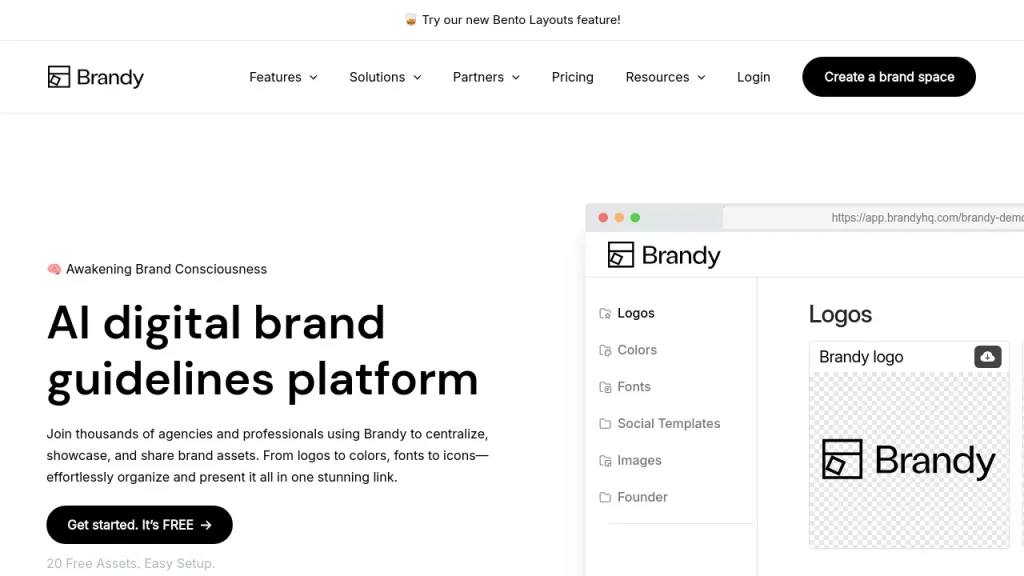
Brandy is built for exactly this transition: from a static brand document to a living, organized, shareable brand hub.
What Brandy gives brand teams:
- Brand spaces that house every approved asset, guideline, and template in one organized, cloud-based location
- Shareable brand kits that give any team, partner, or platform exactly what they need with a single link that always reflects the current version
- Version snapshotting so current assets are always front and center and outdated files are archived, not circulating
- Advanced tagging and metadata so anyone on the team can find the right asset in seconds without hunting through folders
- Permission-based access so that different teams, markets, and external partners see only what is relevant to them
- Support for 30 + file formats with built-in file conversion, so assets are always in the right format for whoever needs them
- SOC 2 Type II compliance for enterprise-grade security
- No per-seat pricing, making it practical for teams sharing access with large numbers of external partners and locations
For brand teams that are not yet managing design tokens at the code level, Brandy provides the brand management foundation that makes the rest possible: a single source of truth, always current and always accessible.
How to Move from a Static Brand Guide to a Living Brand System?
You do not need to overhaul everything at once. Here is a practical starting point.
Audit What You Currently Have
List every brand asset that exists. Identify which are current. Find out where outdated versions are still circulating. This step alone usually reveals more consistency problems than expected.
Centralize Before You Share
Upload every approved asset, publish your brand guidelines, and organize everything in one place before opening access to your team and partners. A brand hub that is empty or disorganized when people first access it creates the same habits as a folder.
Replace the PDF With a Shareable Brand Kit
Instead of distributing a brand guidelines document, build a shareable brand kit that includes your guidelines, approved assets, and key templates in one place. Share a single link. When anything updates, the link reflects the change automatically.
Build Toward Token-Based Color and Typography Management
Even without a full engineering implementation, you can start organizing your brand decisions the way a token system would. Name your colors by their role (“primary,” “secondary,” “accent”) rather than just their values. Document decisions by purpose, not just specification. This makes the transition to a full token system significantly easier when the time comes.
The Bottom Line
A PDF brand guide is better than nothing. But in 2026, it is no longer enough.
The brands that maintain consistency across teams, platforms, and markets are the ones that treat their brand as a living system, not a static document. They update once, and it flows everywhere. Every team member, partner, and platform is always working from the current version.
That is what a living brand system does. And it starts with bringing every asset, guideline, and decision into one organized, accessible, always-current place.
Brandy is built to be that place. Start for free at brandyhq.com.
FAQs: Living Brand Guidelines vs Static Style Sheets
A static style sheet is a fixed document, usually a PDF, that captures brand rules at a single point in time. Living brand guidelines are hosted online and updated in real time, so every team member always sees the current version. The core difference is that static guides go stale the moment something changes, while living guidelines stay accurate without redistribution.
PDF brand guidelines become outdated because they cannot reflect changes after export. Every logo update, color adjustment, or new rule requires re-exporting and re-sharing the file, and old copies keep circulating. This leads to teams unknowingly working from different versions, which is one of the most common causes of brand inconsistency.
Living brand guidelines should include logos with usage rules, color palettes with exact values (HEX, RGB, CMYK), typography rules, imagery, tone-of-voice guidance, templates, and downloadable assets. The key is pairing every asset with its proper context, all in one link that stays current.
Small teams often benefit the most from living brand guidelines. Without a dedicated brand manager, a single always-current source of truth prevents the version confusion that grows quickly as freelancers, agencies, and new hires join. Setup takes minutes with a tool like Brandy, so there is no enterprise-level overhead.
Living brand guidelines improve consistency by removing version ambiguity. Everyone references the same live link, updates propagate instantly, and assets are downloaded from the source rather than dug out of old email threads. Teams stop reproducing outdated logos or colors because outdated copies no longer circulate.