
The way marketing teams manage content has changed permanently. What used to be a back-office file storage problem is now a front-line competitive issue. Digital asset management is no longer a luxury reserved for enterprise brands with massive budgets. It has become the operational foundation that separates fast-moving marketing teams from those perpetually stuck in chaos.
The numbers confirm this shift. The global DAM market was valued at $5.36 billion in 2025 and is projected to reach $19.36 billion by 2034, growing at a 15% CAGR. More telling than the market size is what is driving that growth: brands are realizing that scattered storage, manual workflows, and inconsistent assets are quietly costing them time, money, and customer trust.
For marketing leaders, understanding where digital asset management is heading is not optional. These trends shape how campaigns are built, how teams collaborate, and how brands show up across every channel. Here are the six digital asset management trends you need to understand right now.
Why DAM Is No Longer Just About Storage?
Before diving into individual trends, it is worth understanding the broader shift happening across the industry.
Marketing teams today produce more content than ever, across more formats and more channels, while facing tighter timelines and leaner teams. The average organization now manages thousands of digital brand assets at any given moment, including videos, images, ad creatives, sales decks, social content, and product imagery. Without a system built specifically to handle this volume, things break down fast.
The result is duplicated work, off-brand assets going live, licensing violations, and hours wasted hunting for files that should take seconds to find. DAM platforms exist to solve exactly these problems, and the market is responding accordingly with platforms that are smarter, faster, and more deeply integrated than ever before.
Trend 1: AI Is Transforming How Teams Find and Organize Content
Artificial intelligence is the single biggest force reshaping digital asset management right now. It is moving DAM platforms from passive storage systems into active, intelligent content engines.
Automated Tagging and Metadata Generation Is Saving Hours Every Week
Manually tagging hundreds or thousands of assets has always been one of the most tedious parts of content operations. AI changes this entirely. Modern DAM platforms now use machine learning to automatically generate metadata, apply tags, recognize image content, transcribe audio, and even analyze video frame by frame.
The efficiency gains are significant. Teams using AI-powered DAM systems find the right assets up to 60% faster, and campaign publishing cycles compress by up to 40%. That is not a marginal improvement. For a marketing team running multiple campaigns simultaneously, those savings stack up into a measurable competitive edge.
What this means for your team:
- Assets are tagged consistently the moment they are uploaded
- Search results become accurate and instant rather than approximate and slow
- Teams spend time on campaigns, not on admin
Natural Language Search Is Changing How Marketers Interact With Asset Libraries
Beyond auto-tagging, AI is also transforming the search experience itself. Marketers can now search an entire asset library using plain language, the same way they would type a query into Google. Instead of needing to know the exact file name or tag, a user can type “woman using laptop in bright office” and surface the right images instantly.
This shift has a real impact on asset reuse. When content is easy to find, teams actually use what already exists rather than commissioning new creative from scratch. That reduction in redundant production is a direct ROI gain that leadership can measure.
Trend 2: Centralized Ecosystems Are Replacing Fragmented Storage
One of the most consistent problems marketing leaders face is content scattered across dozens of locations. Files live in email threads, shared drives, Slack channels, agency Dropboxes, and personal desktops. Nobody knows which version is current. Nobody can find the original file. And nobody is confident the asset going out the door is actually on-brand.

The Real Cost of Cloud Storage for Marketing Teams
General-purpose cloud storage tools are built for accessibility, not brand governance. They were never designed to manage approvals, enforce usage rights, maintain version control, or power omnichannel distribution. Using them for brand asset management creates risk at every stage of the content lifecycle.
Organizations that migrate from scattered cloud storage to a purpose-built platform report being able to share assets with internal teams and external partners up to three times faster, while maintaining brand consistency across all channels. The operational case is clear.
One Source of Truth Across Every Team
A centralized platform creates a single, governed repository where creative, sales, product, regional, and external teams all access the same approved content. Every asset is version-controlled, permissions are managed by role, and audit trails track who accessed or modified what and when.
The teams that benefit most from centralization include:
- Regional marketing teams who previously worked from outdated local copies
- External agencies and partners who need reliable access to current brand assets
- Sales teams who need up-to-date collateral when they need it, not when someone remembers to send it
- Creative teams who spend less time fielding asset requests and more time producing
Brandy’s brand management platform for teams makes this possible without the complexity and implementation overhead that slows teams down. Everything lives in one organized, searchable, permission-controlled space.
Trend 3: Workflow Automation Is Accelerating Content Velocity
Campaign timelines are shrinking. Marketing teams are expected to produce more content, across more formats, with the same or smaller teams. The bottleneck is rarely creative talent. It is process.
Where Content Velocity Breaks Down?
The most common content production failure points are approval cycles, version confusion, and manual handoffs between tools. A creative is produced, emailed for review, revised, emailed again, approved in a thread nobody can find later, and then manually uploaded to wherever it needs to go. Every step in that chain is a potential delay and a source of error.
Digital brand management tools with built-in workflow automation eliminate most of this. Approval workflows move assets through review stages automatically, with notifications, commenting, and version comparison built in. Version control ensures nobody is ever working from an outdated file. Distribution workflows push assets to the right channels once approved, without manual uploads.
Businesses that automate content lifecycle management report:
- Up to 30% reduction in manual content maintenance tasks
- Faster campaign launches with fewer revision cycles
- Fewer errors and off-brand assets reaching distribution
Automation That Scales With Campaign Volume
The real value of workflow automation is that it scales. Whether a team is managing two campaigns or twenty, the process works the same way. Requests come in, assets move through review, approvals are tracked, and content deploys without anyone manually shepherding files between tools.
For marketing leaders managing distributed teams across regions, time zones, or partner organizations, this level of automation is not a convenience. It is the only way to maintain quality and speed at scale. Brandy’s advanced collaboration and task mode keeps every stakeholder aligned without the usual back-and-forth overhead.
Trend 4: Brand Consistency Across Omnichannel Has Become Non-Negotiable
Customers interact with brands across more touchpoints than ever before. Social media, email, paid advertising, websites, in-store, partner marketing, and influencer content all need to look and feel like they come from the same brand. When they do not, trust erodes.
The Scale Problem Most Marketing Leaders Are Facing
Maintaining brand consistency across dozens of markets, channels, and campaigns is genuinely hard without the right infrastructure. A brand with operations in multiple regions, working with agencies, resellers, and local marketing teams, cannot rely on manual review processes to catch every off-brand asset before it goes live.
A purpose-built platform solves this by centralizing brand governance. Approved logos, color palettes, typography, imagery guidelines, and templates all live in one place. Teams access only what they are permitted to use. Brand elements can be locked so they cannot be modified. And every asset that leaves the system carries the approval it needs to be there.
Brand Guidelines and Partner Enablement at Scale
One of the most practical tools for brand consistency at scale is a structured brand guidelines hub: a curated, controlled space where external partners, agencies, resellers, or co-brand collaborators can access up-to-date assets without gaining access to the entire asset library.
What controlled brand access enables:
- Agencies always work from the current version of brand assets
- Resellers and retail partners can access product imagery without emailing requests
- Co-brand and influencer campaigns stay on-brand without lengthy back-and-forth
- Legal and compliance teams have clear records of who accessed what
Brandy’s dynamic brand guidelines tool makes it easy to create and share living, web-based brand guidelines that update in real time. Every partner and internal team member always works from the same approved source, no PDF version chasing required.
Trend 5: Security, Rights Management, and Compliance Are Moving to the Forefront
Digital asset security used to be an afterthought. Not anymore. As content libraries grow larger and more valuable, and as regulatory requirements tighten across markets, governance has become a boardroom-level conversation.
Enterprise-Grade Security Is Now a Baseline Expectation
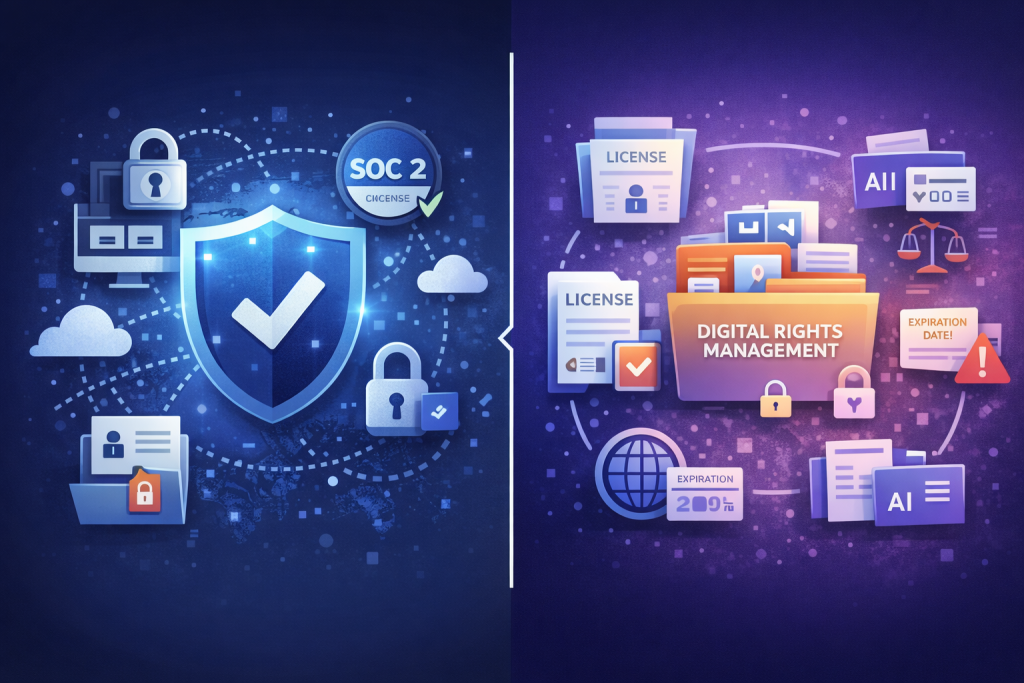
More than 80% of organizations with over 1,000 employees have implemented or are planning to implement a DAM system. As adoption grows in enterprise settings, the security expectations have grown with it. SOC 2 compliance, role-based access controls, audit trails, and data residency options are now baseline requirements, not differentiating features.
For marketing leaders, the security case for DAM is also a risk reduction case. Unauthorized use of assets, expired licenses going unnoticed, and off-brand content reaching the market all carry real financial and reputational consequences. Brandy’s platform features include SOC 2 Type II compliance, private brand spaces, password-protected access, and permission controls that give leadership confidence their assets are protected at every level.
Digital Rights Management in a High-Volume Content World
Rights management has become increasingly complex as content libraries grow and as AI-generated content enters the mix. Marketing teams need to know, with confidence, which assets they are licensed to use, in which markets, on which channels, and for how long.
Understanding the difference between DAM and brand asset management is essential here. DAM platforms with rights management track licensing information at the asset level. Expiration dates trigger alerts before licenses lapse. Usage restrictions are enforced automatically. And as AI-generated content becomes more prevalent, the need to track and label AI-involved assets for compliance purposes is emerging as a new governance requirement that forward-looking platforms are already addressing.
Trend 6: DAM Is Evolving into a Full Content Supply Chain Platform
The final trend is the one that ties all others together. DAM is no longer a destination for finished assets. It is becoming the connective tissue between every part of the content lifecycle.
From Asset Storage to Strategic Growth Engine
Modern DAM platforms integrate with CMS systems, PIM tools, marketing automation platforms, e-commerce platforms, creative tools, and social media management software. The result is a connected content supply chain where assets flow between systems automatically, without manual downloads, uploads, or reformatting.
This level of integration is where the ROI of DAM becomes most measurable. Research shows the return on investment from DAM systems ranges between 8:1 and 14:1. Those returns come not just from time saved on asset search, but from faster campaigns, higher asset reuse rates, fewer production errors, and better brand governance across the board.
The capabilities defining next-generation DAM platforms include:
- AI-driven predictive tagging and asset recommendations based on usage patterns
- Automated content publishing to websites, storefronts, and social channels
- Deep integration with creative tools so designers work without switching platforms
- Analytics showing which assets are used, reused, and performing best
What This Means for Marketing Leaders Right Now?
The marketing leaders treating DAM as infrastructure are already ahead of those still relying on general cloud storage and manual workflows. The gap between these two groups will widen significantly over the next two to three years as AI capabilities mature and content volumes continue to grow.
Explore the best brand asset management tools available to benchmark where your current stack stands against what modern platforms now make possible. The difference between tools built for storage and tools built for brand governance is not subtle. It is the difference between reacting to brand problems and preventing them.
The Bottom Line
Digital asset management trends point in one clear direction: DAM is becoming the operational center of modern marketing. AI is making content discovery faster and more accurate. Centralized ecosystems are eliminating the silos that slow teams down. Workflow automation is removing the manual steps that bottleneck production. Omnichannel brand consistency is moving from aspiration to expectation. And security, rights management, and deep platform integrations are separating the platforms built for scale from those that will struggle to keep up.
Marketing leaders who act on these trends now will build faster, more consistent, and better-governed content operations. Those who wait will find themselves managing a growing problem with shrinking tools.
The market has spoken. DAM is no longer a storage solution. It is a strategic growth engine. The only question left is whether your organization is ready to use it that way. Get started with Brandy for free and see what modern brand asset management looks like when it is built for the way marketing teams actually work.