Brand Management Blog & Resources
Rebranding projects rarely fail because of bad design. They fail because expectations are misaligned from the start. Leadership wants speed. Teams want clarity. Customers want consistency. Somewhere in between, timelines stretch, decisions stall, and the rebrand starts to feel endless.
A successful rebrand is not a quick refresh. It is a structured transformation that touches strategy, systems, people, and measurement. When any of those elements are rushed or skipped, the timeline suffers later. What looks like saving time early usually creates delays during rollout and adoption.
This guide breaks rebranding into five practical phases with realistic timeframes. It is designed for modern marketing and brand teams who want momentum without chaos. The goal is not to move fast at any cost. The goal is to move with intention and avoid rework.
The Five Phase Rebranding Timeline At A Glance
A complete rebranding timeline typically spans six to nine months, sometimes longer for complex organizations. The exact duration depends on scope, readiness, and internal alignment. What matters more than speed is sequence.
The five phases are:
- Phase one focuses on discovery and strategy
- Phase two sets up the tools and infrastructure
- Phase three covers brand design and development
- Phase four enables internal rollout and adoption
- Phase five launches externally and measures impact
Each phase builds on the previous one. Skipping ahead may feel productive, but it often creates confusion later. This framework keeps teams aligned while allowing flexibility where it matters.
Phase 1: Discovery and Brand Strategy

Timeline 4 to 6 weeks
This is the most important phase of the entire rebranding timeline. It is also the one teams are most tempted to rush. When discovery is weak, every phase that follows becomes harder.
Why Most Rebrands Fail Before Design Even Starts
Before asking how the brand should look, teams need to understand why the rebrand is happening. Growth, mergers, market repositioning, reputation recovery, and product evolution are strong strategic reasons, while fatigue with the current logo or pressure to look modern rarely justify the effort.
Rebrands often consume ten to twenty percent of a marketing budget. They also demand time from leadership, marketing, sales, product, and operations. During peak periods, thirty to fifty percent of team capacity can be affected. Without a clear strategic reason, the cost quickly outweighs the value.
This phase validates whether a rebrand is necessary and what success should look like if it moves forward.
Brand Audit Market Research and Competitive Analysis
A rebrand should respond to reality, not assumptions. This starts with a brand audit that looks at how the brand is currently perceived internally and externally.
Key questions include
- What does the brand stand for today
- Where is it strong
- Where is it inconsistent
- How does it compare to competitors
- What gaps exist in the market
Market research and competitor analysis help teams identify opportunities for differentiation. This is not about copying competitors. It is about understanding the landscape clearly enough to make confident decisions.
Centralizing insights, research documents, and findings during this phase prevents repeated discussions later. When information is scattered, decisions slow down and alignment breaks.
Defining Rebrand Objectives Success Metrics and KPIs
One of the most common causes of timeline creep is unclear success criteria. If teams cannot agree on what success means, they will struggle to agree on when the work is done.
Objectives should connect brand outcomes to business outcomes. Examples include:
- Improved brand recognition
- Stronger trust signals
- Higher engagement across channels
- Better asset adoption internally
- Increased efficiency for marketing teams
KPIs should be defined early so measurement is not an afterthought. This also ensures the rebrand can be evaluated objectively instead of emotionally.
Creating The Rebranding Brief That Aligns Everyone
The rebranding brief is the anchor for the entire project. It documents the strategy, goals, audience, positioning, tone, constraints, and success criteria.
A strong brief reduces debate later. It gives designers clear direction while helping stakeholders assess work using the same criteria. By setting expectations early, it also protects the timeline from unnecessary scope drift.
Housing the brief and all supporting materials in a central location ensures everyone works from the same source of truth. When teams rely on memory or outdated files, confusion follows.
Phase 2: Setting Up the Right Rebranding Infrastructure
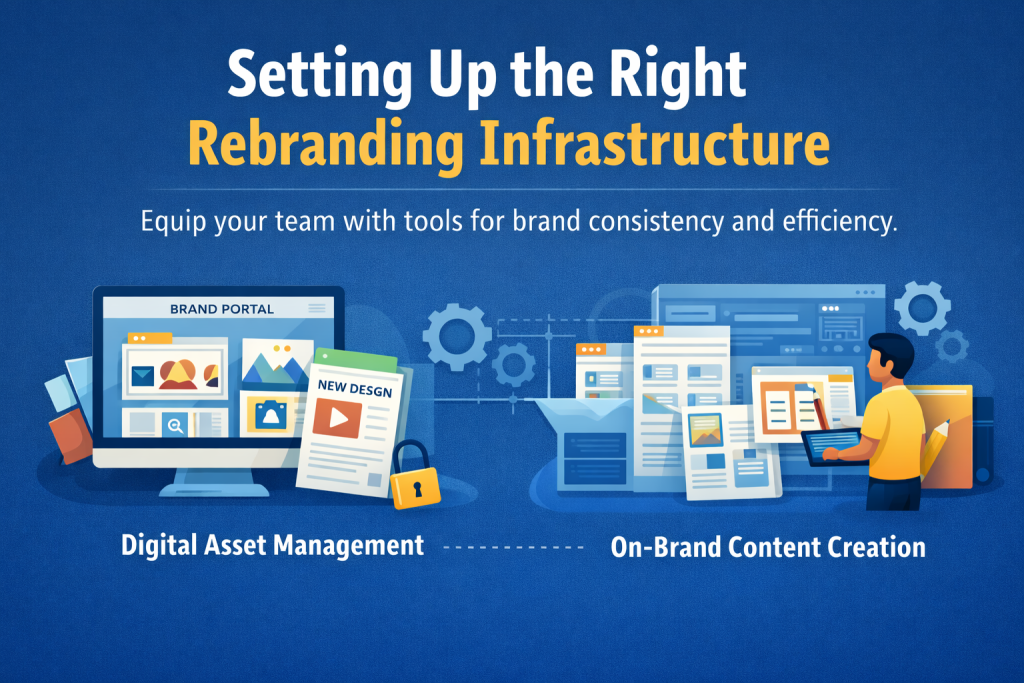
Timeline 2 to 4 weeks
Before anything is rolled out internally or externally, teams need the right systems in place. Tools do not replace strategy, but without them, even the best strategy struggles to scale.
Why Tools Should Come Before Rollout Not After
Many teams wait until launch to think about systems. By then, assets are already scattered. Teams are improvising. Brand consistency starts breaking before the new identity even settles.
Rebranding creates a surge of new content including logos, templates, campaign assets, guidelines, and training materials. Without proper structure, this volume quickly overwhelms teams and slows execution.
Setting up infrastructure early keeps momentum high during later phases.
Digital Asset Management As The Foundation
A Digital Asset Management system acts as the central home for the new brand. It stores approved assets, controls access, manages versions, and ensures teams always use the latest files.
During a rebrand, assets evolve quickly. Without version control, outdated logos and visuals continue circulating. DAM prevents this by making the correct assets easy to find and easy to use.
A brand portal within the DAM also helps internal and external stakeholders access what they need without constant manual sharing.
On Brand Content Creation For Speed And Consistency
Rebranding is not just about guidelines. It is about execution at scale. On brand content creation tools allow teams to produce marketing materials quickly while staying compliant.
Templates for presentations, social posts, sales decks, and regional campaigns reduce dependency on central teams. They also shorten approval cycles and protect brand consistency.
When teams can create content confidently within guardrails, adoption increases and timelines stay intact.
Phase 3: Brand Design and Development

Timeline 6 to 8 weeks
This is the phase most people associate with rebranding, but by the time teams reach this stage, many of the hardest decisions should already be made. Strategy provides the guardrails. Design brings it to life.
Defining Brand Messaging and Narrative
Brand messaging goes beyond taglines and headlines. It defines how the brand explains its value, speaks to its audience, and differentiates itself in the market.
This phase focuses on:
- Core positioning statements
- Key messages for priority audiences
- Proof points that support credibility
- A consistent narrative across channels
Messaging must remain consistent as it appears in websites, campaigns, sales conversations, and customer communications. Centralizing approved messaging ensures teams do not reinterpret the story differently as content scales.
Visual Identity System and Style Guidelines
The visual identity includes logos, color palettes, typography, imagery, and layout principles. But the real output of this phase is not just design files. It is documentation.
A strong style guide explains:
- How assets should be used
- Where flexibility is allowed
- What not to do
- How visuals adapt across formats
Version control matters here. As designs evolve, teams need access to the latest approved assets. Without a clear system, outdated visuals continue appearing long after launch.
Establishing Brand Voice and Tone
Brand voice defines how the brand sounds in writing and conversation. It shapes emails, landing pages, social posts, product messaging, and support interactions.
This phase clarifies:
- Personality traits of the brand
- Tone variations by context
- Words to embrace and words to avoid
- Examples that make guidance practical
Accessible brand voice guidelines reduce interpretation errors and help teams apply the brand consistently without constant review cycles.
Phase 4: Internal Rollout and Brand Enablement

Timeline 4 to 6 weeks
A rebrand succeeds or fails internally before it ever reaches the public. Employees are the first brand ambassadors, and their understanding directly impacts consistency.
Why Internal Adoption Decides External Success
If teams are confused, hesitant, or unsure how to apply the new brand, inconsistencies appear immediately. Sales decks look different from marketing campaigns. Regional teams improvise. Momentum stalls.
Forrester refers to this as functional interlock. Every department plays a role in delivering the brand experience, not just marketing.
Internal Communication Planning
Internal rollout starts with clear communication. Teams need to understand why the rebrand happened, what changed, and what is expected of them.
Effective internal communication includes:
- Leadership alignment and messaging
- Transparent timelines
- Clear explanations of benefits
- Open channels for questions
Centralized access to announcements, presentations, and updates reduces confusion and builds confidence.
Training Teams To Apply The Brand Correctly
Training turns guidelines into action. This includes:
- Live or recorded walkthroughs
- Role specific examples
- Easy access to templates and assets
- Clear guidance on when to ask for help
Studies show that seventy two percent of employees lack a clear understanding of their company’s brand strategy. Training closes this gap and protects the investment made in earlier phases.
Phase 5: External Launch Measurement and Ongoing Management

Timeline 6 to 8 weeks and ongoing
External launch is not the finish line. It is the beginning of brand performance tracking and long term management.
Coordinating The External Launch
External rollout often spans multiple channels at once, including website updates, campaigns, social media, press announcements, and sales enablement materials.
Sequencing matters. When channels launch out of sync, confusion follows. A centralized workflow ensures assets are used consistently and messaging stays aligned.
Measuring Rebrand Impact With The Right Metrics
Measurement connects brand work to business outcomes. Metrics commonly tracked after launch include:
- Net promoter score
- Social engagement
- Customer retention
- Revenue growth
Tracking adoption of new assets internally also reveals whether the brand is being used correctly. Measurement should be ongoing, not limited to launch month.
Brand Maintenance And Evolution
Brands are not static. Markets shift. Products evolve. Teams grow. A rebrand must be managed continuously to stay effective.
This requires:
- Clear ownership
- Governance without friction
- Systems that adapt as the brand grows
A structured platform for managing guidelines, assets, and approvals makes brand evolution manageable instead of disruptive.
How Long Does Rebranding Really Take
Most organizations expect rebranding to take three to six months. In practice, many projects extend to a year or more. Delays usually stem from unclear objectives, poor alignment, or lack of systems.
When teams invest in discovery, infrastructure, and internal enablement early, timelines become more predictable. The work moves forward with fewer resets and less rework.
Common Rebranding Timeline Mistakes to Avoid
Avoiding these mistakes protects both budget and momentum.
- Skipping discovery to save time
- Designing without clear success metrics
- Launching externally before teams are ready
- Treating measurement as optional
- Relying on manual processes to manage assets
A Rebranding Timeline Is a Framework Not a Deadline
A strong rebranding timeline provides structure without rigidity. It guides teams through complexity while allowing space for iteration and learning.
The long term value of rebranding comes from consistency, measurement, and adaptability. When teams have a system that supports these principles, rebranding becomes a foundation for growth rather than a one time project.
FAQs about Rebranding Timeline
Most rebranding initiatives span six to twelve months depending on scope, internal readiness, and rollout complexity. Larger organizations with multiple regions or product lines often require more time for alignment and adoption.
Discovery validates why the rebrand exists, aligns stakeholders, and defines measurable goals. Without this phase, teams risk misalignment that leads to delays and inconsistent execution.
Teams need a reliable branding software stack including a Digital Asset Management system, a central brand portal, and on brand content creation tools to ensure consistency from day one.
Clear communication, structured training, accessible guidelines, and easy to use templates help employees apply the brand correctly. Making compliance simple increases adoption.
Success is measured through a combination of brand awareness, engagement, customer perception, asset adoption, and operational efficiency. Ongoing measurement enables continuous improvement.